Imagine that you are sitting in a Guangzhou tea house. The dim sum is exquisite, the pu’er tea is bottomless, and at the table next to you, a man in a polo shirt and a pair of bright red plastic flip‑flops is casually paying for lunch with a credit card that could probably cover your rent. No one else in the room even glances at his feet. For many foreign visitors, this is a genuine moment of culture shock, not a dramatic one like a loud market or an unfamiliar dish, but a quiet, persistent confusion. Why do so many people in Guangdong, rich and poor alike, seem to wear slippers everywhere? If you are the kind of traveller who wants to go beyond the postcard and genuinely understand a place, this is exactly the kind of puzzle worth solving. And the best tool for the job is one that cross‑cultural trainers have been teaching for decades: the D.I.E. model.
The D.I.E. Model: A Tool for Deeper Travel

When we encounter unfamiliar behaviour abroad, our brains like to jump straight from observation to judgment. We see a thing, we attach a feeling, and we file it away. The D.I.E. model, originally developed in intercultural communication, forces us to slow down and separate that process into three deliberate steps: Describe, Interpret, and Evaluate.
Describe is what you actually saw, the raw data without adjectives. Interpret is a brainstorming of possible meanings, both positive and negative, without settling on one. Evaluate is the final step where you choose the most likely interpretation, ideally after gathering more information from locals, reading, or asking questions. The model is not about excusing behaviour or deciding who is right. It is about delaying your verdict long enough to learn something real. For a traveller who wants to move from seeing a city to understanding a culture, it is a superpower.
Describe: The Shoes on the Ground
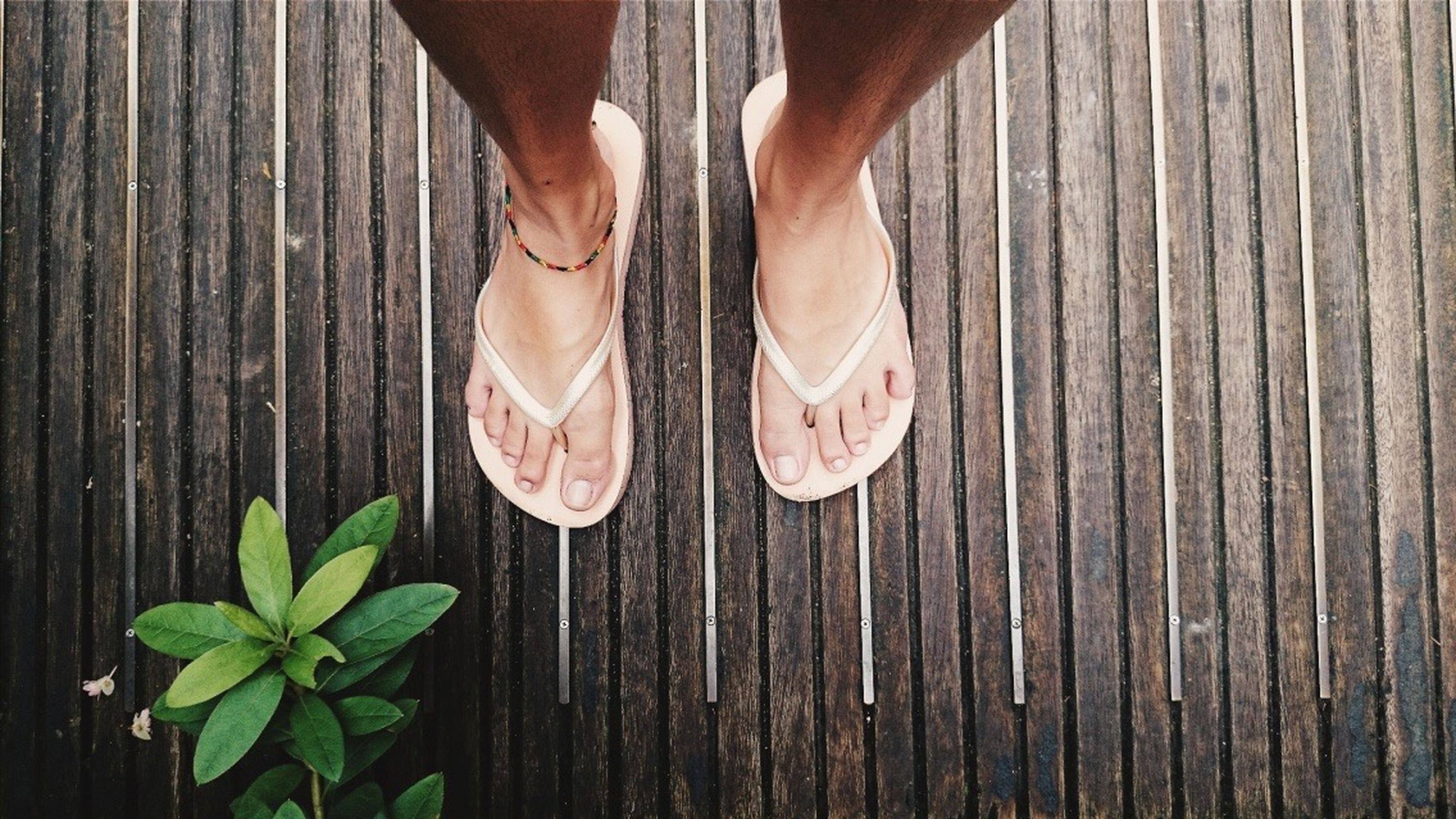
Let us start with Describe. What does a foreign visitor actually observe in Guangdong, across Guangzhou, Foshan, Dongguan, and the towns of the Pearl River Delta? You notice that a significant number of residents wear slippers or flip‑flops in settings that, in a Western or North Asian capital, would call for leather shoes, sneakers, or at least sandals with a back strap. You see them in shopping malls, in restaurants, at neighbourhood markets, and even, occasionally, spilling out of luxury car dealerships. The footwear is often the humble rubber thong, sometimes branded, sometimes not, in colours that range from beige to neon. The wearers do not appear self‑conscious. They move as if wearing the most natural thing in the world. You also notice that this is not confined to one social class. Office workers who slip into flip‑flops the moment they leave their desks, elderly aunties carrying vegetables, and young couples on a date all seem to share the same relaxed relationship with their toes.
Interpret: The Stories Our Brains Invent
Now comes the Interpret step. A foreign mind, untethered from local context, will quickly generate a list of possible explanations. Some are charitable, some less so. A visitor might think: these people are lazy about their appearance. Or perhaps they are poor and cannot afford proper shoes. Maybe it is a sign of disrespect, a refusal to dress appropriately for public life. Another might decide it is simply a tropical beach culture thing, like wearing flip‑flops in Thailand or Hawaii, and stop thinking altogether.
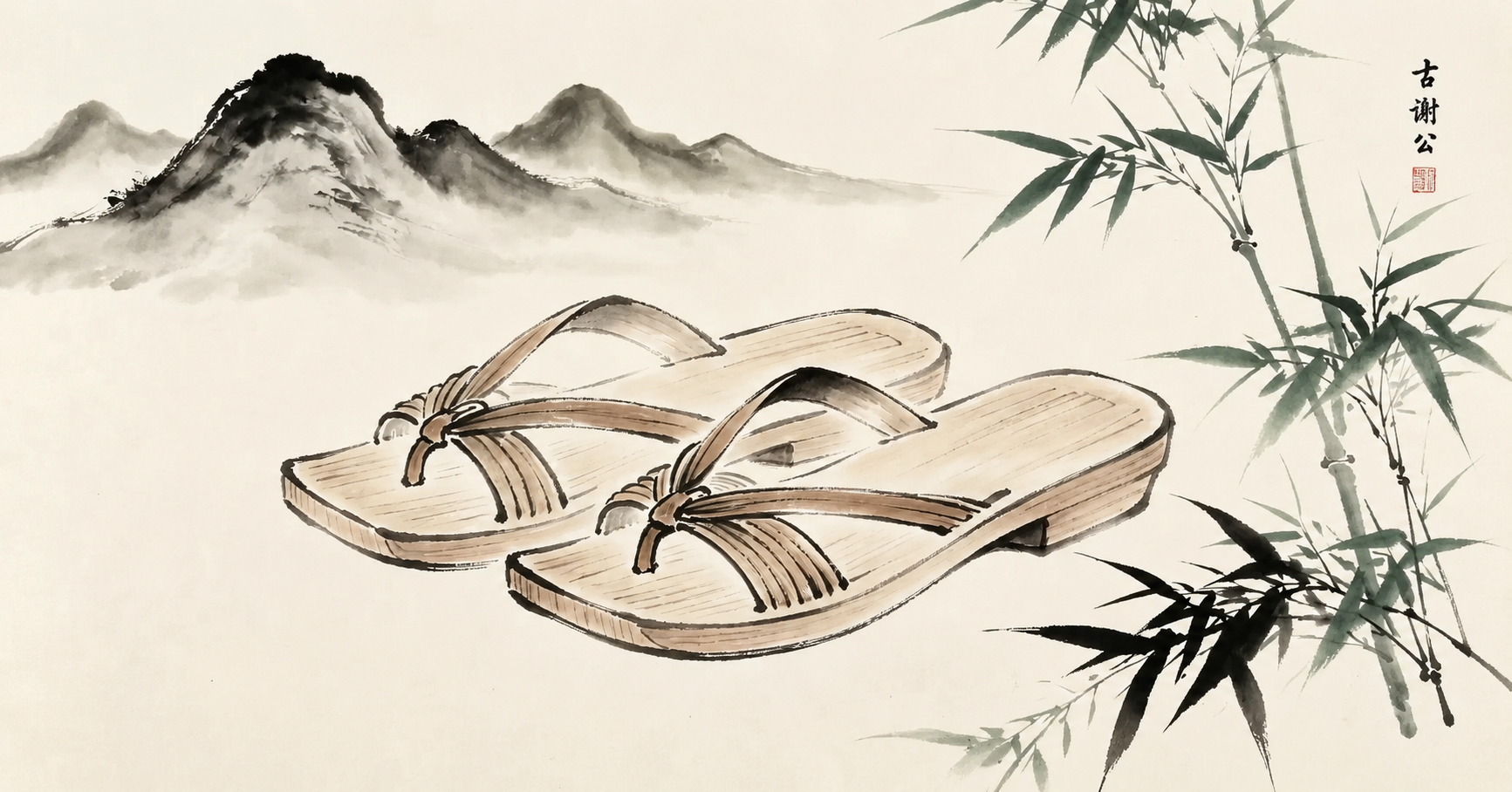
Vintage Lingnan wooden clogs immortalized in Chinese ink art — the classic slip-on shoes worn by ancient Cantonese folk wandering misty southern hills and bamboo groves
But pause. There are other possible interpretations. Perhaps the climate has something to do with it. Guangdong is hot and humid for much of the year, with sudden rainstorms that turn streets into shallow rivers. Enclosed shoes become a sweaty, impractical misery. Wearing something light, quick‑drying, and easily removed is not laziness; it is adaptive intelligence. Perhaps there is a historical dimension. Before rubber flip‑flops, people in Lingnan wore wooden clogs, the famous muji (木屐), which were even praised by ancient poets like Li Bai. The preference for freeing the feet might be centuries older than anyone realises. Perhaps it is a philosophical choice, a deliberate rejection of the status anxiety that makes people in colder, more formal cities dress to impress strangers. What if the man in the red flip‑flops at the tea house is perfectly aware that he could afford Italian leather shoes, but simply does not feel the need to prove it? What if the absence of fashion pressure is the point? These are all plausible interpretations. The D.I.E. model does not ask you to pick one yet. It simply asks you to hold them all in mind, like a handful of puzzle pieces.
Evaluate: What the Locals Can Teach You
The final step, Evaluate, requires you to gather more information. You ask a local friend. You read. You dig a little. And the picture that emerges is both simpler and more profound than the first hot‑take judgments.
Yes, climate is the practical bedrock. Guangdong’s subtropical weather makes enclosed shoes a sticky ordeal from May to October, and the region’s frequent typhoon‑season downpours make waterproof sandals a no‑brainer. But practicality alone does not explain why a billionaire would wear the same two‑dollar slippers as a market porter. The deeper explanation is cultural, and it runs through the entire Cantonese worldview.
Guangdong has been a centre of commerce since the Tang Dynasty. Its merchant class accumulated vast wealth, but unlike the landed gentry of the north, they did not inherit status. They earned it through trade, hustle, and a sharp eye for value. This bred a culture deeply suspicious of ostentation. Showing off was not only vulgar; it was bad for business. A real estate tycoon in flip‑flops and a plain cotton shirt is not being lazy. He is signalling that his worth needs no branding. This pragmatic, egalitarian spirit, often summarised by locals as “comfort over appearance” or “substance over form,” extends across class lines. The office worker who kicks off her heels at 6 p.m. is not giving up on life. She is reclaiming her evening from the tyranny of dress codes.
Historical echoes reinforce this. The wooden clogs of ancient Lingnan were worn by scholars, poets, and peasants alike. The “Xie Gong clogs” invented by the poet Xie Lingyun were a fashion item of their day, but they were always about freedom of movement. The chronicles of the Qing Dynasty describe Cantonese people of all classes wearing clogs in any weather, favouring lightness and comfort above all else. This was not a temporary trend. It was a continuous thread of material culture, interrupted only by the mid‑20th century, then revived in rubber. When you see a flip‑flop today, you are looking at a direct descendant of a Tang‑era clog.
The cultural confidence to break international dress codes is also part of the picture. When the young Cantonese diver Quan Hongchan showed up at the Paris Olympics wearing whimsical “ugly fish” slippers, foreign media were charmed but a little baffled. For Guangdong residents, it was a moment of recognition: she brought a piece of home to the world’s most formal stage. The indie band Wutiaoren, known for wearing classic red flip‑flops on stage, turned the footwear into a symbol of southern Chinese nonconformity. This is not a culture that forgot to dress up. It is a culture that decided dressing up was optional.
So where does the Evaluate step land? The most reasonable interpretation, grounded in history, climate, and economics, is that the ubiquitous flip‑flop is a material expression of a deeply rooted Lingnan ethos: be real, be comfortable, and do not waste energy on performances. It is not a fashion failing. It is a philosophy you can wear.
Seeing Beyond the Flip‑Flop
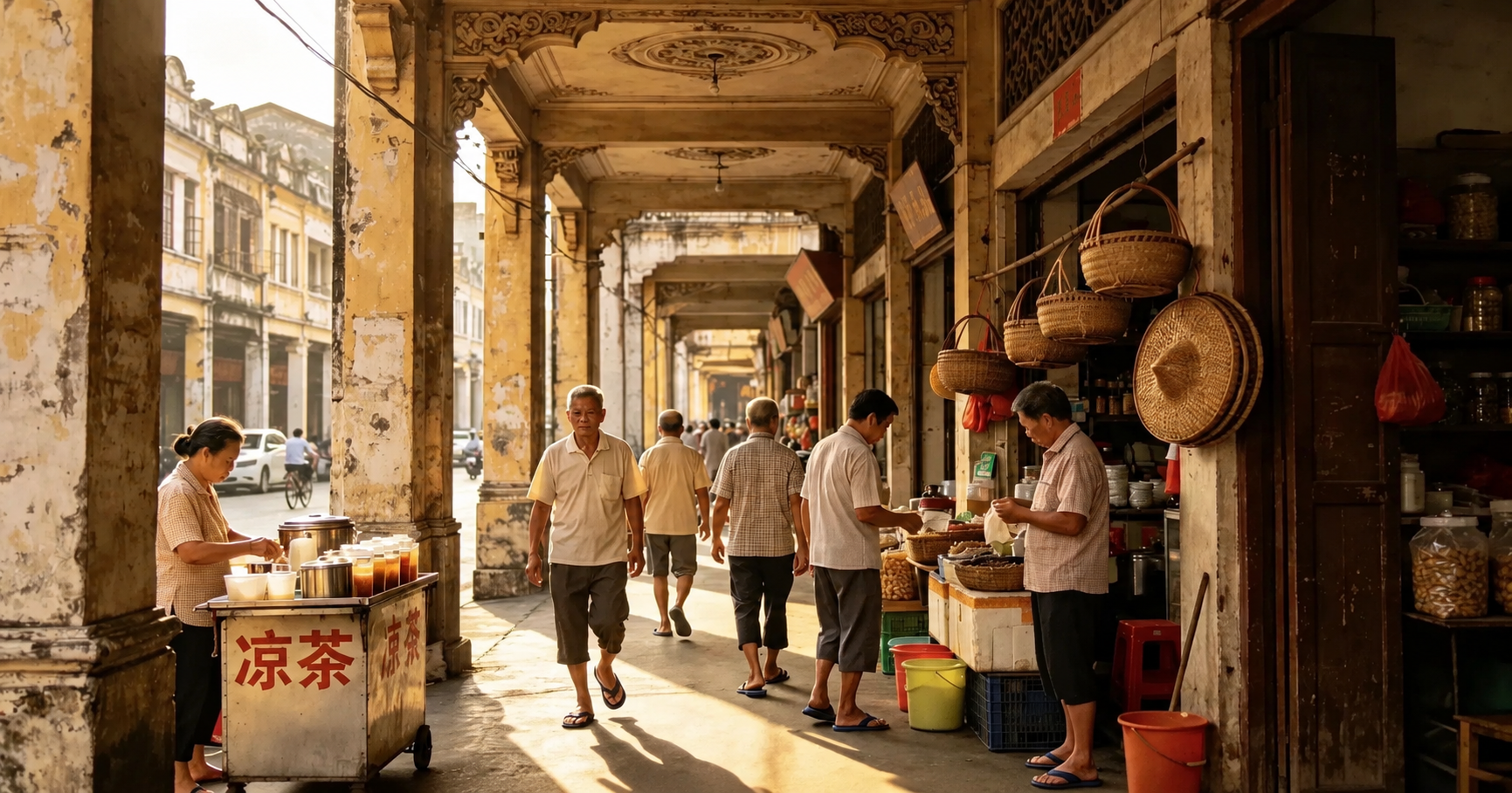
Worn flip-flops, aged arcades, and slow Cantonese street vibes: this is genuine old-town Guangdong at its most laid-back
This is what cross‑cultural travel can offer that a checklist tour never will. The flip‑flop is not a funny quirk to photograph and forget. It is a doorway into how Cantonese people think about status, comfort, community, and the good life. To step through that doorway, however, you need more than a phrasebook. You need someone who can translate not just words, but the unspoken values that make a region tick.
That is exactly the kind of experience Into South China designs. Our guides are not just English‑speaking logistics managers. They are locally born, cross‑culturally trained interpreters who have lived, studied, or worked abroad and understand exactly where a Western, Middle Eastern, or Southeast Asian traveller’s assumptions might lead them astray. When you walk with us through a Guangzhou wet market or a Foshan ancestral temple, we do not just name the vegetables or the deities. We help you apply the mental tools, like the D.I.E. model, that turn confusing moments into cultural insights. We connect what you see, like a pair of flip‑flops on a millionaire, to the history of the Maritime Silk Road, the pragmatism of Cantonese merchants, and the rhythm of subtropical daily life. This is what we mean by Experience South China Like a Local. Not just tasting the dim sum, but understanding why the person serving it might be wearing bathroom slippers with pride.
So next time you catch yourself staring at a pair of flip‑flops in a five‑star hotel lobby, do not let your brain jump to judge. Describe. Interpret. Evaluate. And if you want a little help with that final step, you know where to find us.