It is a Sunday afternoon in Shenzhen, and beneath the banyan trees of Lianhua Hill Park, something deeply strange to a foreign eye is unfolding. Rows of umbrellas shade not picnickers but printed resumes, each one pinned to a string and facing outward like a shop window display. The resumes do not advertise job skills. They list age, height, salary, property ownership, zodiac sign, and a photograph of a young man or woman who may or may not know their details are being exhibited. The people standing beside the umbrellas are not the singles themselves but their parents, mostly in their fifties and sixties, clutching thermoses of tea and scanning the crowd with a mixture of hope and quiet desperation.

Top-down drone view capturing the iconic heart-shaped dating corner in Shenzhen’s Lianhuashan Park
This is a Chinese marriage market, or xiangqin jiao, and for many international visitors on a China travel itinerary, it looks like a cross between a job fair and a street auction. It is perhaps the most visible, unfiltered window into how China thinks about love, partnership, and the future of the family. For a foreign traveler, it is also an unmissable cultural encounter, one that can spark an entire China travel journey into understanding modern Chinese life. And it begins with a single question: why do Chinese parents try so hard to get their children married, and why do they do it in public parks?
The Return of the Matchmaker, With a Spreadsheet
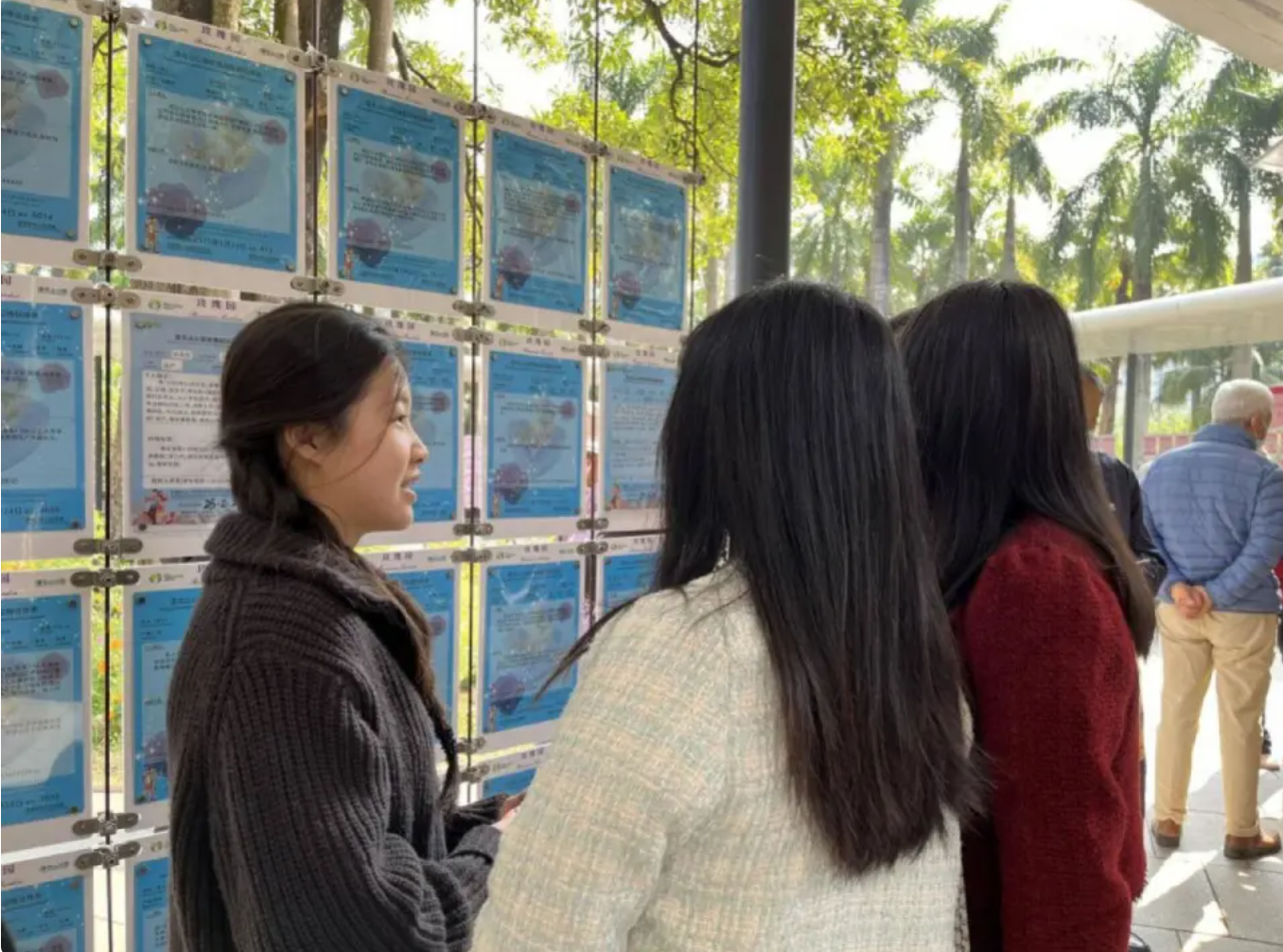
Three young ladies read through countless personal dating flyers hanging on the wall at Shenzhen Lianhuashan Park’s matchmaking corner
To grasp the marriage market, you first need to understand xiangqin, or arranged dating. Unlike the blind dates of the West, which often feel casual and low-stakes, Chinese xiangqin carries the weight of two families evaluating each other's suitability for a lifelong merger. It is not simply two individuals falling in love. It is a negotiation between households over shared values, economic stability, and social standing. This is not a new phenomenon; it is a revival of a tradition that stretches back centuries, when matchmakers would shuttle between families with red silk cords and dowry lists. What has changed is the modern setting and the specific anxieties that fuel it.
In today's China, young people are delaying marriage. University, career pressures, and the sheer cost of living in cities like Shenzhen or Guangzhou push the average marrying age well into the late twenties or early thirties. Parents, shaped by Confucian values that define a person's fulfillment through family lineage, begin to panic when a child passes twenty-five without a partner. The result is the park market: a grassroots, parent-driven networking event where mothers and fathers exchange WeChat contacts on behalf of their absent sons and daughters.
The criteria are famously transactional. A typical resume might read: "Male, 29, 178 cm, master's degree from Sun Yat-sen University, annual salary 400,000 RMB, owns an apartment in Nanshan with mortgage, no car." Women's listings often highlight their age (youth is prized), height, education, and a gentle personality. This can feel jarring to a visitor from, say, Germany or Australia, where listing your salary on a first date would be considered crass. But here, it is practical honesty. Marriage, in the Chinese framework, is not simply the culmination of romantic love. It is the foundation of a stable life, and stability requires material security. For anyone on a China travel adventure, witnessing this upfront offers a raw, unfiltered glimpse into local priorities that no museum exhibit can replicate.
Bride Price and the Economics of Trust
Nowhere does this material dimension become clearer than in the custom of caili, the bride price. A groom's family is expected to give a substantial sum of money, often accompanied by a house, a car, or gold jewelry, to the bride's family before the wedding. In some regions, this can amount to hundreds of thousands of yuan, enough to bankrupt a family. The practice frequently makes headlines, with stories of last-minute price hikes or couples breaking up over failed negotiations.
For a Western visitor accustomed to two people pooling their savings for a honeymoon, bride price can seem like an outdated purchase. But a cross-cultural comparison can soften the judgment. In many African societies, for example, the tradition of lobola serves a similar purpose: a groom's family transfers cattle or cash to the bride's family as a gesture of respect, a pledge of the groom's ability to provide, and a bond between kin groups. In parts of Latin America, while a direct bride price is uncommon, elaborate wedding costs are often shouldered by the bride's family, and extended family approval is critical. Even in the United States, an engagement ring worth three months' salary was once the accepted benchmark, a direct economic signal of commitment.
What makes China's bride price distinctive today is its escalation. In the 1980s, a sewing machine or a bicycle might suffice. Today, skyrocketing housing prices and a gender imbalance (a legacy of the one-child policy) have inflated expectations. For many Chinese women, bride price is not about being sold; it is about security in a society where divorce laws and social welfare still leave married women vulnerable. For parents, it is a tangible proof that their daughter will be cared for. Understanding this does not require you to endorse it, but it opens a window into the economic anxieties that shape modern relationships. For China travel visitors curious about social dynamics, this is a conversation starter that leads deep into the heart of contemporary China.
When a Foreigner Enters the Park
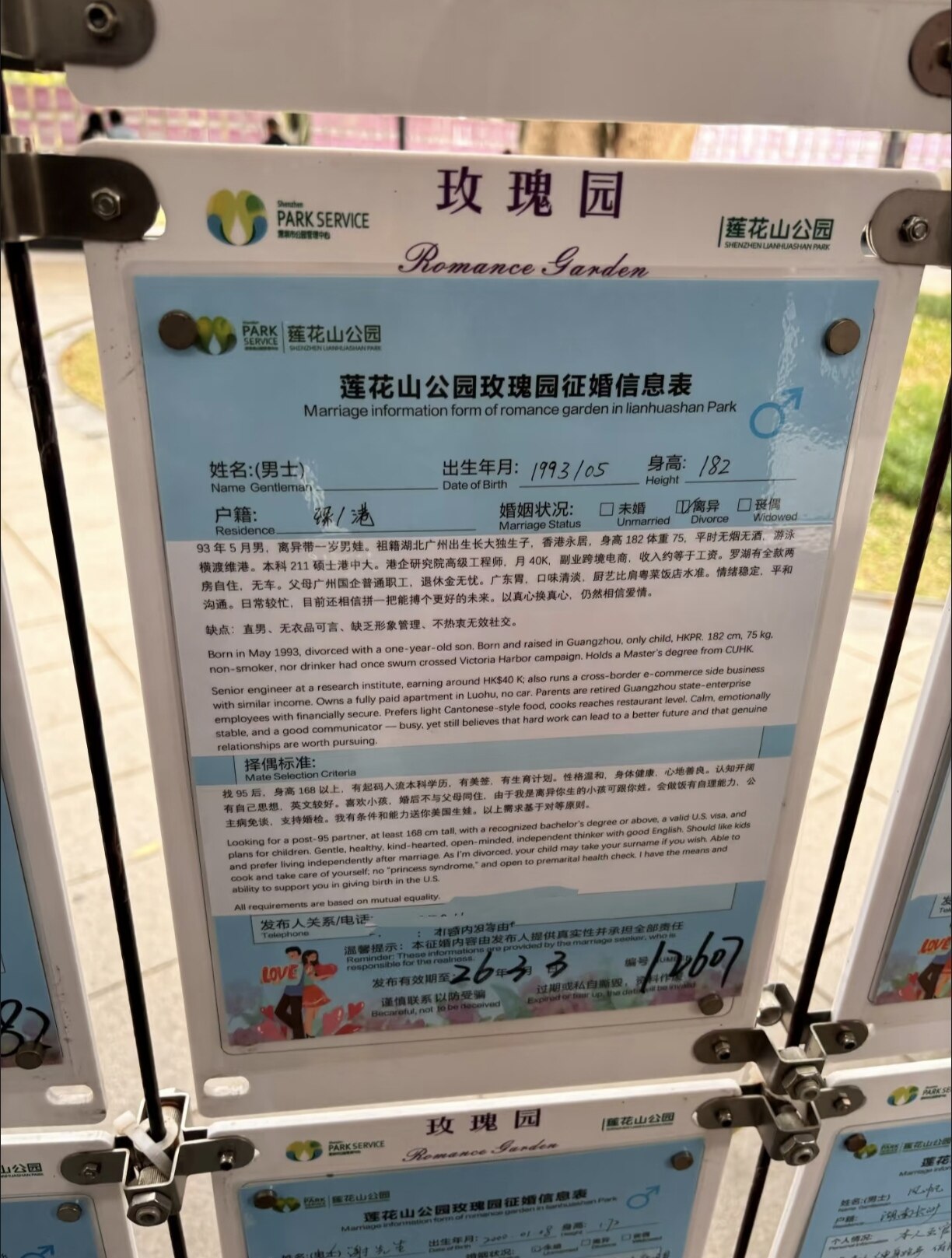
A piece of dating information in Chinese and English displays at the heart of Lianhuashan Park’s matchmaking zone
For an international visitor, walking through Lianhua Hill's marriage market can be surreal, but also surprisingly participatory. The parents are often delighted to chat with a foreign face, even if their English is limited. "Where are you from? Are you married? How old are you?" The questions come fast, and before long, a Dutch traveler might find his height and eye color being assessed as potential son-in-law material. One American tourist, a tall software engineer from California, once told me he spent an afternoon at the park and left with a dozen parent contact cards, all inviting him for dinner to meet their daughters. He did not go on any of those dates, but he gained a vivid lesson in Chinese family values that no museum exhibit could match. It became, he later said, the most memorable stop on his entire China travel itinerary.
The park is also a living museum of generational tension. Most of the children whose resumes hang on the strings have no desire to be there. They may roll their eyes at their parents' meddling, yet many silently accept the help, too busy with their careers or too shy to navigate the dating world alone. Other young Chinese are rejecting the system entirely, fueling a rise in singlehood, childfree lifestyles, and online communities that celebrate independence. The tension between tradition and autonomy is palpable, and it is the same tension driving social change across China. Observing this drama is a highlight for many China travel explorers seeking more than just scenic photos.
Rent-a-Girlfriend and the Golden Week Pressure
Beyond the park, a whole ecosystem of quirky marriage customs exists that can delight and baffle a visitor. During Spring Festival, the pressure on singles to bring a partner home is so intense that a black market of rental boyfriends and girlfriends has flourished on e-commerce platforms like Taobao. For a fee, a young woman will pose as a loving girlfriend for the holiday, enduring family banquets, fending off questions, and returning the red envelopes of cash at the end of the stay. It sounds like a romantic comedy, but it is real, and it speaks to the immense weight of filial piety. Parents do not simply want their children to marry; they need them to marry, so that the family line continues and holiday rituals are properly observed. A single person at a reunion dinner is an unfinished sentence. For the curious China travel visitor, timing a trip during Spring Festival can offer a front-row seat to these social pressures playing out in real time.
Then there is Singles' Day, November 11, originally a campus celebration of being unattached. The e-commerce giant Alibaba transformed it into the world's largest online shopping festival, a twist that reveals much about China's consumer culture. The same loneliness that drives parents to the parks also drives young people to console themselves with retail therapy. For a visitor, timing a China travel trip to witness both the marriage market and a Singles' Day shopping spree offers a multi-dimensional portrait of modern love.
From Park to Red Sofa: TV Dating Shows
If the park is the offline hub, China's television dating shows are its digital counterpart. Fei Cheng Wu Rao ("If You Are the One"), a long-running reality program, places a single male contestant before twenty-four women who signal their interest by leaving their podiums. The questioning can be brutal: "Do you own a house? What is your monthly salary? Why are you still single at thirty?" It is a televised marriage market, complete with flashy lights and a sharp-tongued host, and it has been watched by millions across Asia, Europe, and Africa. The show is a global hit precisely because it dramatizes the universal tension between romantic idealism and hard-nosed reality, a tension that every culture navigates differently. Even catching a single episode on a hotel TV can become an unexpected China travel memory.
Cross-Cultural Reflections: How Love Is Negotiated
To grasp what is distinctively Chinese, it helps to place these customs alongside their counterparts elsewhere. In the United States and much of Western Europe, the dominant script is one of individual choice: two people meet, fall in love, and then perhaps introduce each other to their parents. The family's opinion is advisory, not decisive. The concept of a public resume-for-marriage would strike most New Yorkers or Londoners as an invasion of privacy. Yet in parts of southern Europe and Latin America, families still exert considerable influence, and a suitor who did not seek a father's blessing might be viewed with suspicion. In Ghana or Kenya, bride price negotiations are formal affairs involving entire clans, and a marriage is seen as a joining of communities, not just individuals. Even in Russia, where matchmaking was once an art, modern dating apps now coexist with a lingering parental concern over "suitable" matches.
What China presents is a hybrid: a hyper-modern, tech-savvy society that pays for groceries with facial recognition, yet still mobilizes parents as matchmakers in urban parks. The smartphone and the umbrella stand side by side. This fusion is precisely what makes it so fascinating for an international visitor on a China travel journey. It is not a fossilized tradition but a living adaptation of old values to new pressures.
Experiencing the Marriage Market, and Beyond
If you find yourself in Shenzhen, a Sunday stroll through Lianhua Hill Park is essential. Go in the late morning, when the market is at its busiest. Do not just observe; talk to the parents. With a translation app or a local guide, you can ask about their child, their criteria, and their hopes. You will likely be surprised by their warmth and their willingness to share stories. They might even offer you a cup of tea. If you feel bold, you can even play the role of a prospective suitor yourself, handing your own "resume" to a parent and watching the negotiation unfold. It is a moment of cross-cultural theatre you will never forget, and a true highlight of any China travel experience in Shenzhen.
For a deeper experience, Into South China can arrange a guided visit that goes beyond the park. You can sit with a local family over a home-cooked meal and hear firsthand how marriage customs have evolved across generations. We can organize a tea-house discussion where a cross-cultural guide breaks down the economics of bride price, the history of matchmaking, and the generational tensions that shape today's dating scene. For a truly hands-on immersion, we can set up a mock matchmaking session where you learn to decode a park-style resume, practice the small talk of parental negotiations, and understand the unspoken signals that a local would recognize instantly. Our guides, many of whom have lived and studied abroad, will help translate not just the language but the cultural logic, turning a curious spectacle into genuine insight. This is China travel at its most meaningful: not just seeing, but understanding.
Love as a Lens
Chinese courtship, with its parks, prices, and parental pressure, can seem alien. But it is also a mirror reflecting universal human concerns: the search for security, the desire for connection, the fear of loneliness, and the deep need to belong to a family. Every society answers these needs in its own way. In China, that answer is written on A4 paper and hung from an umbrella. It is not strange so much as it is honest, and it is exactly the kind of honest, unfiltered encounter that transforms a trip into a genuine cultural China travel journey.
The next time you are in Shenzhen, skip the skyscraper viewing deck for an afternoon and head instead to Lianhua Hill. Under the banyans, you will find a living theater of love, fear, and hope. You might even find your own resume pinned up, if a certain mother has her way. That, too, is part of the China travel adventure.