
The first thing I noticed about Guangzhou was not the skyline, though the Canton Tower does pierce the clouds like a needle of light. It was the smell. Not the exhaust fumes you brace for in a city of eighteen million, but something deeper, earthier: dried seafood hanging from market awnings, roasting chestnuts on a street corner, and the faint, sweet perfume of jasmine tea drifting from a doorway where an old man sat reading a newspaper. I had come to China expecting megacities and neon. But here, on my first morning in Guangzhou, I found myself standing in a wet market with a basket in my hand and Ling, our guide, at my side. Born and raised in Guangdong, Ling would be with us for the entire journey – a constant thread of local knowledge, wit, and warmth. "Today," she said, "you choose what we cook." And just like that, my five‑day journey through the Greater Bay Area, this experiment in experiencing South China not as a tourist but as a participant, had begun.
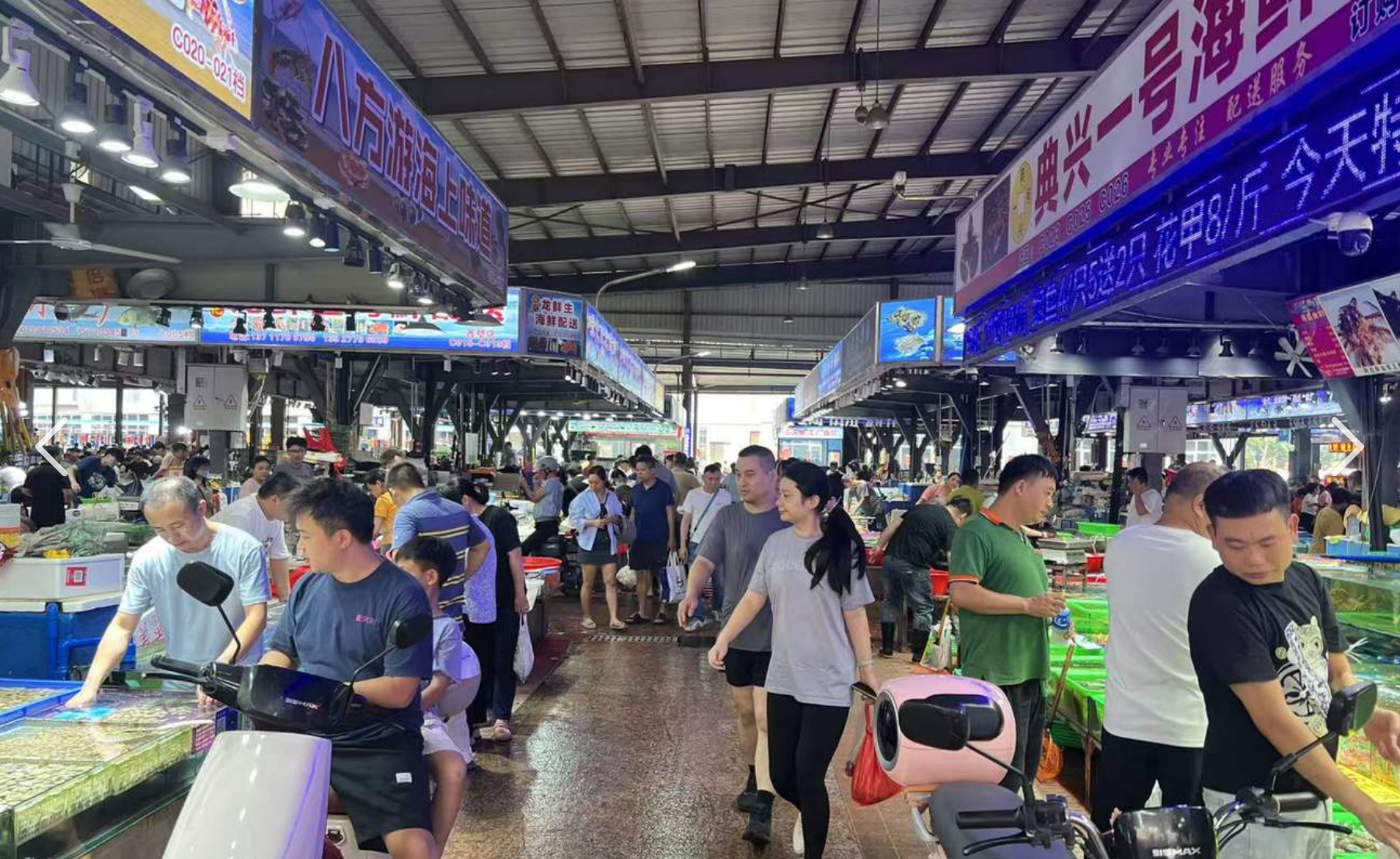
An unfiltered slice of everyday Guangzhou life, touring a bustling indoor market with a resident, selecting fresh ingredients to prepare a traditional
home-style Cantonese meal
The market was a symphony of chaos and order. Vendors called out their prices in rapid Cantonese, their voices overlapping like instruments in a jazz band. A fishmonger slapped a gleaming grouper onto his block and gave me a grin that said, "You're not from around here, are you?" I pointed at the fish and nodded. He wrapped it in newspaper, and I added it to my basket. Ling guided me through the maze, explaining the ingredients that define Cantonese cooking: dried scallops that add umami to soups, bitter melon that cools the body in the subtropical heat, and the silken tofu that appears in countless dishes. Back in a private kitchen, a chef taught me to stir‑fry river shrimp with garlic and ginger, the wok hissing as the ingredients hit the hot oil. He explained wok hei, the "breath of the wok", that smoky, charred flavor that separates good Cantonese cooking from great. My first attempt was clumsy. My second was better. By the third, I was flipping shrimp like I had been doing it all my life. We ate our creations at a long table, a German software engineer, a Brazilian graphic designer, and a retired Australian couple, all united by the simple pleasure of food made with our own hands. In the afternoon, Ling took us through the winding lanes of Liwan District, the old Guangzhou of arcaded streets, medicine shops, and tea houses that have been pouring for over a century. I watched an elderly woman weigh dried herbs on a brass scale, her movements as precise as a surgeon's. I tasted a tea that smelled of orchids and tasted of honey. That evening, we cruised the Pearl River, the skyline lighting up like a circuit board, but I found myself staring at the river itself, the same water that had carried traders, exiles, and dreamers for two thousand years.
The train to Foshan took just forty minutes. I spent it staring out the window as the skyscrapers gave way to villages, then to the green fields of the Pearl River Delta. Foshan, I had read, was the birthplace of Wing Chun, the martial art that Bruce Lee had mastered before creating his own Jeet Kune Do, and a place where kung fu was not a performance but a way of life. Ling led us to Ip Man's Former Residence, a modest house where the grandmaster had lived and trained. The rooms were small, filled with photographs and artifacts, but what struck me most were the walls: fist marks left in century‑old brick, the silent evidence of thousands of hours of practice. At a nearby dojo, a master, a direct disciple of Ip Man's lineage, taught me the Wing Chun stance. "Now punch," he said. "Not from the shoulder. From the center." He adjusted my elbow by a fraction of an inch. "Try again." This time, the punch felt different, sharper, faster, as if my body had suddenly discovered a new way to move. After a lunch of claypot rice and greens, we visited a lion dance cultural center. A young performer handed me the seven‑pound lion head. "Now try the basic walk," he said. I stumbled through the steps, the head bobbing awkwardly, but he gently corrected my posture. "Look up," he said. "The lion is proud. Show me proud." I lifted the head, and suddenly I was not a clumsy traveler anymore; I was a lion, powerful and alive. The room erupted in laughter, and I grinned inside the mask.
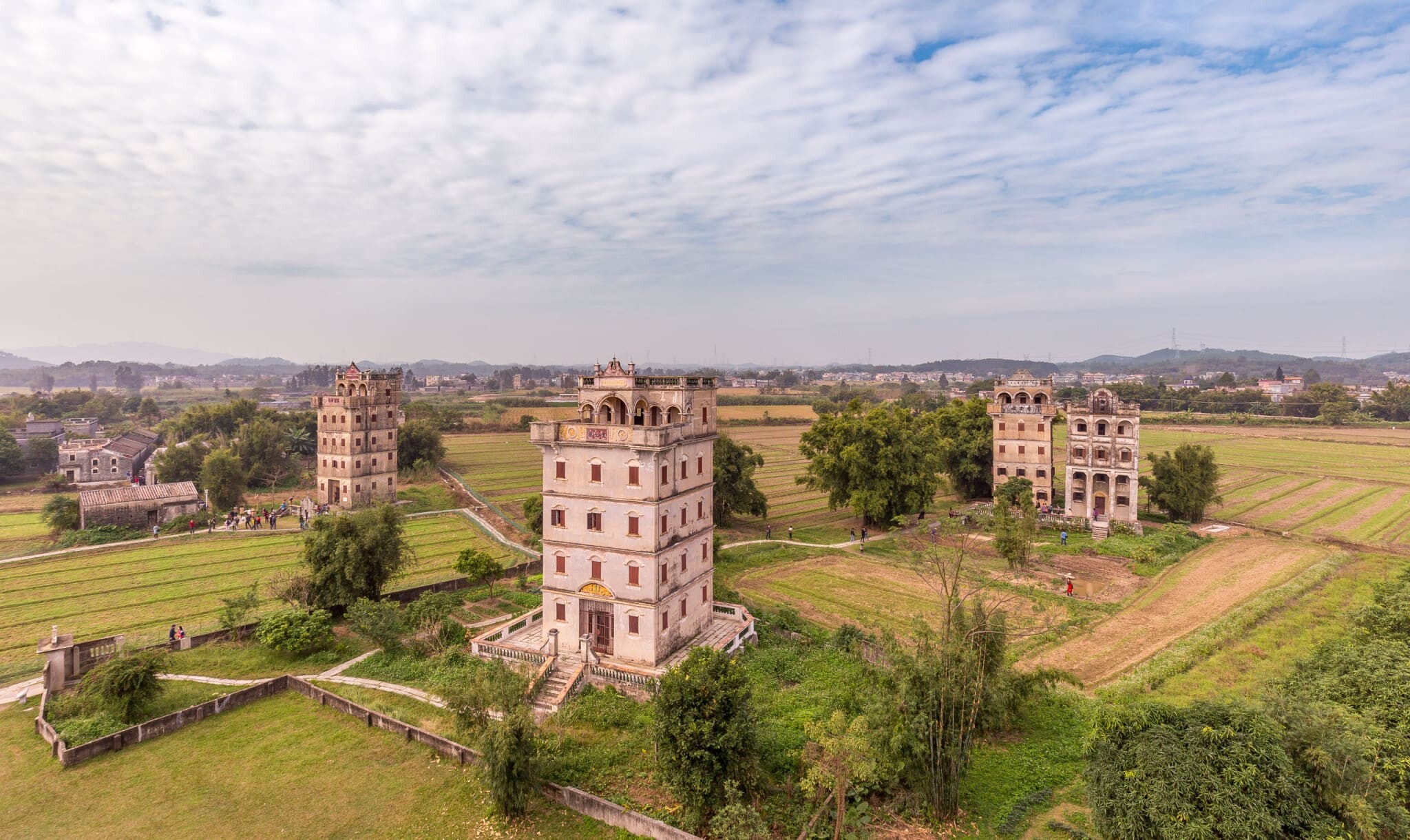
Stretching across the fertile rural plains, the Kaiping Diaolou are extraordinary fortified tower homes inscribed on the UNESCO World Heritage List
Jiangmen was quieter, slower, haunted by the ghosts of those who had left. Ling, who had grown up hearing stories of overseas Chinese from her own grandparents, told us that Jiangmen was the "World Capital of Overseas Chinese", a place where families had been divided by oceans, where men had left for distant shores to send money home, and where they had built extraordinary watchtowers that still stand as monuments to their sacrifice. We visited the Kaiping Diaolou, a UNESCO World Heritage site, fortified towers, some seven stories high, rising from rice paddies like stone sentinels, blending Chinese and Western architectural styles in ways that seemed impossible. Ling led us through Zili Village, where each tower told a story of a family's journey across the seas. I climbed to the top of one tower, the wooden stairs creaking beneath my feet, and looked out over the endless green fields, imagining the men who had stood in this same spot, watching for danger, waiting for letters from across the sea. In the afternoon, we visited a chenpi workshop, where tangerine peels were aged for years, even decades. A local woman showed us how to peel the tangerines in a single, unbroken strip, then sun‑dry them on bamboo trays. "The older the peel," she said, "the more valuable it is. This one is fifteen years old." She held out a shriveled brown curl, and I inhaled its deep, earthy fragrance, a scent of time itself. We tasted the difference between fresh and aged peel, the contrast startling. That evening, we dined on a chenpi feast, chicken infused with aged peel, soups that carried its warm, citrusy notes, and I thought of the overseas Chinese who had carried these flavors across oceans, the ingredients that kept them connected to home.
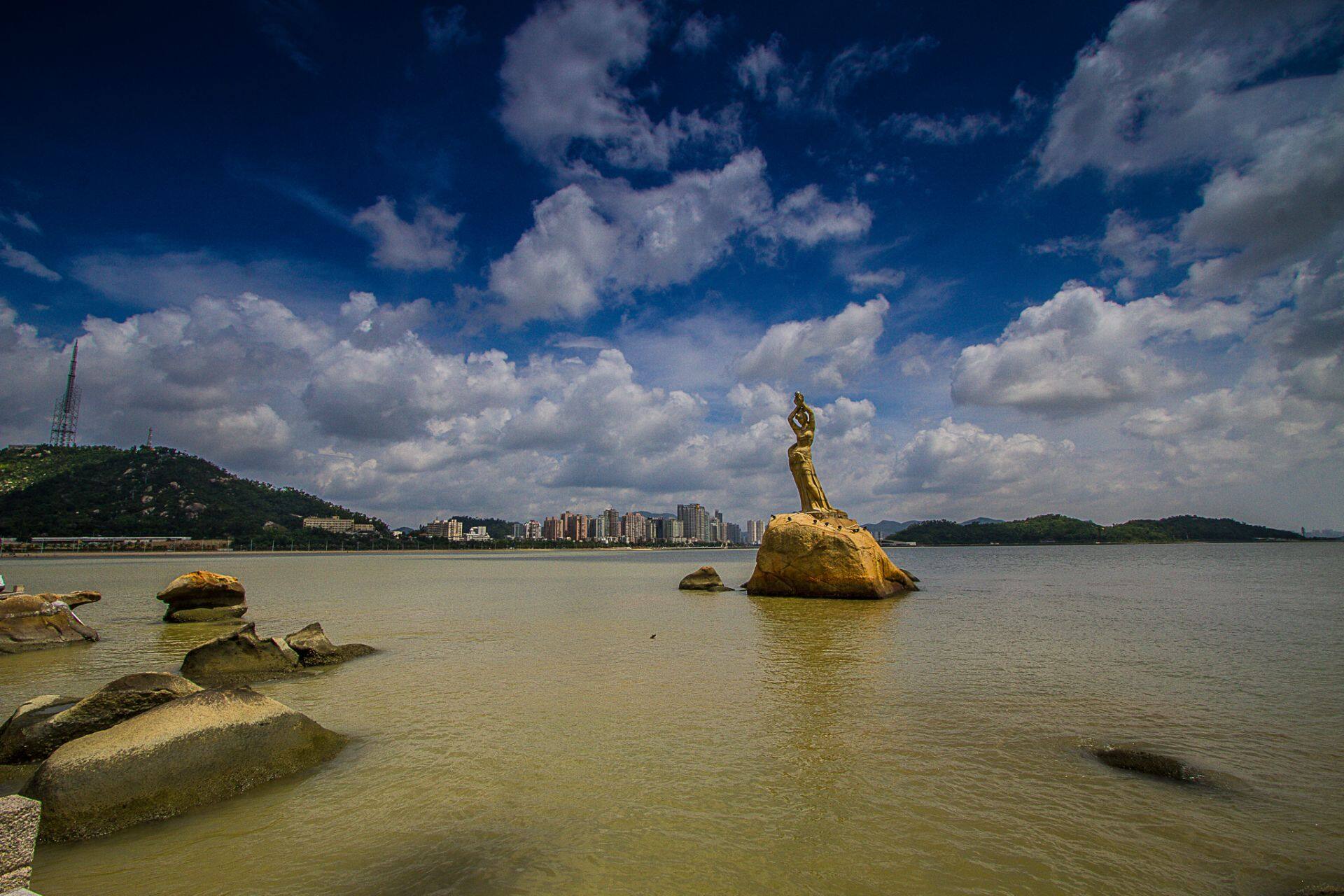
Perched on a natural rock outcrop overlooking the calm waters of the Pearl River Estuary, the Fisher Girl Statue is the beloved landmark of Lovers’ Road
Zhuhai was a different pace altogether, relaxed, a coastal city where the sea breeze softened the edges of everything. We started the day at a seafood market, where vendors displayed their catch on beds of ice: mantis shrimp, crabs, oysters, and fish I couldn't name. Ling showed us how to choose the freshest seafood: clear eyes, closed shells, and we selected a feast of prawns, clams, and a crab that was still waving its claws. A nearby restaurant cooked it for us, the processing fee minimal, the result unforgettable: the prawns were sweet and snappy, the clams bathed in a garlicky broth, the crab so fresh I could taste the sea. After lunch, we rented bicycles and rode along Lovers' Road, a coastal promenade stretching along the shore. The sun was warm, the breeze gentle, the views across the South China Sea breathtaking. We passed the Fisher Girl statue, a symbol of Zhuhai, and the Sun Moon Shell, a concert hall that looked like it had been dropped from the sky. I rode in silence, the wind in my face, feeling the stress of the past days melt away. That evening, we stood on a viewing platform overlooking the Hong Kong‑Zhuhai‑Macao Bridge, the world's longest sea‑crossing bridge, as dusk fell and its lights flickered on, stretching across the water like a string of pearls. Ling told us the story of its construction: eight years, fifty‑seven billion dollars, over forty thousand workers. "It connects three cities," she said, "but it also connects people."
I woke early on the final day, a mix of excitement and reluctance. Today, I would cross the bridge to Hong Kong, a city I had dreamed of visiting for years, but I would also be leaving behind the cities that had become familiar: Guangzhou's markets, Foshan's training halls, Jiangmen's watchtowers, Zhuhai's sea breeze. The journey across the bridge was surreal: forty minutes gliding across the water, passing artificial islands and an underwater tunnel, the views spectacular, the sea on both sides, the distant outlines of Hong Kong's mountains, the sky above impossibly blue. I thought about the engineer who had dreamed this bridge into existence, the workers who had made it real, and the families who would use it to reunite, to cross borders that once seemed insurmountable. We arrived at Hong Kong's Lantau Island, where a representative from Into South China was waiting. My journey was over, but it was also just beginning. From here, I could connect to the airport, explore Hong Kong's vibrant neighborhoods, or even extend my stay with another Into South China tour. I realized that I had not just visited South China. I had cooked in its kitchens, trained in its dojos, walked through its history, and ridden along its coast. I had met its people, the vendors, the chefs, the masters, the storytellers, who had opened their doors and shared their lives with a stranger. I understood what "experiencing like a local" really meant: connecting to the food, to the history, to the rhythm of daily life. It was about the fist marks in a century‑old brick, the weight of a lion head on your shoulders, the taste of fifteen‑year‑old chenpi on your tongue. It was about realizing that you were not just visiting a place. You were becoming part of its story.
On the plane back to my own country, I looked out the window at the clouds below. I could still smell the ginger and garlic from the cooking class. I could still feel the stance of the Wing Chun master. I could still see the lights of the bridge stretching across the water. I had come to China expecting megacities and neon. What I had found was something richer, something deeper: a world of flavors, sounds, and stories that would stay with me long after I had left. And I knew, with absolute certainty, that I would be back.
Why Into South China?
As a specialist inbound travel agency covering Guangdong, Guangxi, Hainan, Hong Kong, and Macau, we do not sell cookie‑cutter tours. We craft experiences that connect travelers to the living traditions of this region, through the people who keep them alive. Our guides, like Ling, are not just translators. They are food enthusiasts who know every stall in Guangzhou's wet markets, martial arts practitioners who have trained in Foshan's Wing Chun halls, and storytellers who can bring the history of the Kaiping Diaolou to life. We have built relationships with the families, masters, and artisans who open their doors to our guests, access that independent travelers simply cannot arrange on their own. From seamless logistics to insider access, we handle every detail, so you can focus on what matters: the taste of a dish you cooked yourself, the feel of a Wing Chun punch you learned from a master's disciple, and the stories that connect you to a culture that has endured for millennia.
Ready to experience South China like a local? Contact Into South China today to start planning your Greater Bay Area journey.
The markets are calling. The masters are waiting. The bridge is open.
Client Review
"An unforgettable journey through South China's most breathtaking landscapes and cultural treasures. Every detail was perfectly arranged, from authentic local experiences to comfortable accommodations. Highly recommended for travelers seeking genuine immersion!"
Trip Highlights
- ✓
Authentic Local Experiences
Immerse yourself in daily life, culture, and traditions of South China
- ✓
Scenic Natural Wonders
Breathtaking landscapes from karst peaks to tropical beaches
- ✓
Culinary Discoveries
Taste regional specialties and authentic local flavors
- ✓
Cultural Heritage Sites
Explore ancient temples, historic architecture, and UNESCO sites


