You land at Guangzhou Baiyun International Airport, eager to navigate the metro into the city. You open Google Maps. Nothing loads. You try to message your family on WhatsApp. Silent. You attempt to translate a street sign with Google Translate. Frozen. For many foreign travelers, the first encounter with China's internet landscape is a sudden, disorienting wall, especially when you have just left a world where everything was a tap away.
The Great Firewall blocks Google services, Facebook, Instagram, WhatsApp, YouTube, X (Twitter), and countless other platforms you rely on daily. Meanwhile, some local apps expect a Chinese phone number for registration, and your foreign SIM card might drain your wallet with roaming fees. But with a little advance planning, these obstacles melt away. This guide lays out every practical solution, from SIM cards and VPNs to offline workarounds and regional tips specific to South China. By the time you finish reading, you will know exactly how to stay connected, navigate confidently, and even share your journey in real time.
1. The Connectivity Trifecta: Roaming, eSIM, or Local SIM
Your first decision is how to get online. Three main routes exist, each with trade-offs.
Option A: International Roaming
Activate roaming on your home carrier's plan before departure. When you land, your phone connects to a Chinese network, but data traffic may be routed back through your home country, allowing you to access blocked sites without a VPN. For example, a UK Three SIM or US T‑Mobile plan often lets you use Google and WhatsApp as if you were still at home.
Pros: No setup, no extra SIM, no VPN needed for blocked services.
Cons: Expensive (around US$10/day on some carriers), and you still lack a Chinese phone number for local apps that demand one. It works best for very short trips where cost is not a concern.
Option B: Travel eSIM
If your phone supports eSIM (most recent iPhones, Google Pixels, and high-end Samsungs do), you can buy a data-only eSIM from providers like Airalo or Holafly. Install it before you fly, activate data roaming upon arrival, and you will have internet in minutes. Many eSIMs route traffic through Hong Kong or Singapore, granting access to blocked services.
Pros: Affordable, instant connectivity, no physical SIM swap, you keep your home number active for calls and SMS.
Cons: Usually data-only (no Chinese phone number), so you cannot receive SMS verification codes for local apps; you still need a VPN if the eSIM uses mainland routing (check provider details). For South China, buying an eSIM that routes through Hong Kong is ideal, given the proximity and reliable cross‑border connectivity.
Option C: Chinese Local SIM Card

China's three major telecom operators
Purchasing a physical SIM from China Unicom, China Mobile, or China Telecom gives you a genuine Chinese phone number. This is the golden ticket for registering on local apps like Meituan, Dianping, and some bike‑sharing services. You will need to present your passport at an official carrier store, airport counter, or after ordering online for pickup.
China Unicom is generally the most foreign‑friendly, with strong urban coverage across Guangzhou, Shenzhen, and Nanning. China Mobile has the widest rural coverage if you plan to visit Guangxi's karst valleys or Hainan's interior. China Telecom offers competitive tourist packages and works especially well in southern provinces.
Pros: You get a local number for app verification, calls, and SMS; data plans are cheap (e.g., 30GB for 15 days at around US$17).
Cons: The local SIM uses mainland routing, so Google and Instagram are blocked unless you use a VPN. You also need an unlocked phone and must complete real‑name registration with your passport.
For South China specifically: If you land in Hong Kong or Macau first, consider picking up a Hong Kong SIM card (from China Mobile HK, 3HK, or CSL). Many Hong Kong SIMs offer mainland China roaming packages that include data usable across the border and, crucially, keep international internet access intact without a VPN. They also give you a Hong Kong number, which can receive SMS verification for some apps. This is a favorite trick of frequent travelers who hop between Hong Kong and Shenzhen.
2. The VPN Solution: Your Key to the Open Internet
If you choose a local Chinese SIM or an eSIM with mainland routing, a VPN is essential to access blocked sites. A VPN encrypts your traffic and tunnels it through a server outside China, making it appear as if you are browsing from another country.
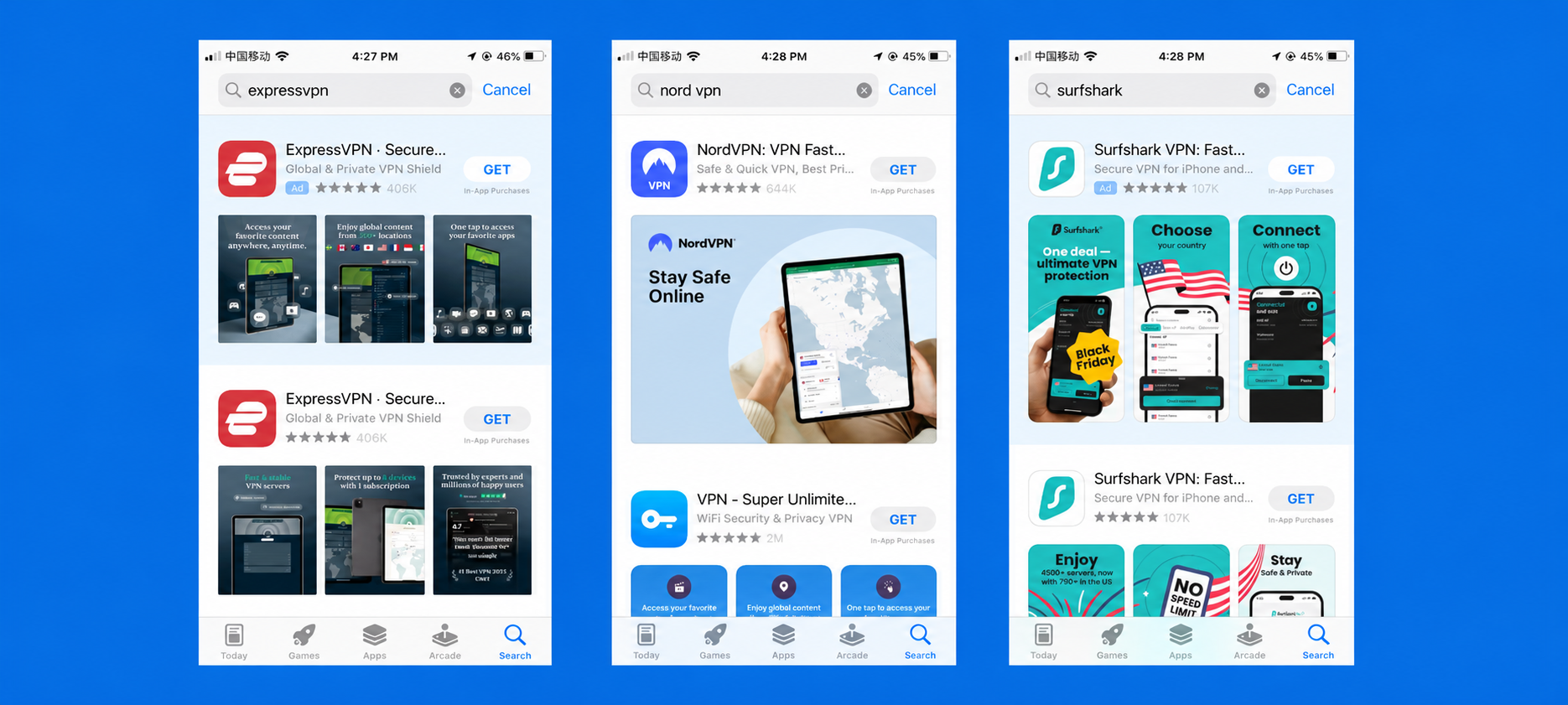
Buy and install your VPN before you arrive in China
Buy and install your VPN before you arrive in China, as many VPN websites are blocked once you are on a Chinese network. Established international providers like ExpressVPN, NordVPN, and Surfshark generally work well, but reliability can vary month to month, so check recent user reports for China travel in forums like Reddit. Some China‑specific VPNs such as Astrill and LetsVPN are also popular among expats.
Keep your VPN app updated before departure. Install it on all devices you plan to use. And remember, you only need to switch on the VPN when accessing blocked services. For local apps like Alipay or Didi, turn it off to enjoy faster speeds.
3. Offline Tools: No Internet, No Problem
Even with the best SIM plan, signal can drop in remote areas like the Longji Rice Terraces or the volcanic coast of Weizhou Island. Prepare offline fallbacks so you never feel stranded.
Maps: Download offline maps in advance. Google Maps allows offline downloads, but it struggles to locate some Chinese addresses. A better alternative is Baidu Maps or Amap (Gaode), both with English interfaces in recent versions. You can pre‑download city maps for all of South China over Wi‑Fi before heading out.
Translation: Google Translate’s offline language packs (Chinese Simplified) are a lifesaver. Microsoft Translator also works well offline and supports image translation. For a local option, Baidu Translate offers robust offline functionality and understands Cantonese‑accented speech, handy in Guangzhou and Hong Kong.
Payments: Alipay and WeChat Pay function offline for QR code payments once set up. Link your international card before your trip, and you will not need data to pay at a vendor. Small shops might still require you to scan a QR code, so have a little data ready or use cash as a backup.
4. Apps That Work Without a Chinese Number, and Those That Do Not
Many travel‑essential apps now accept international phone numbers for registration. This is a huge relief for short‑term visitors.
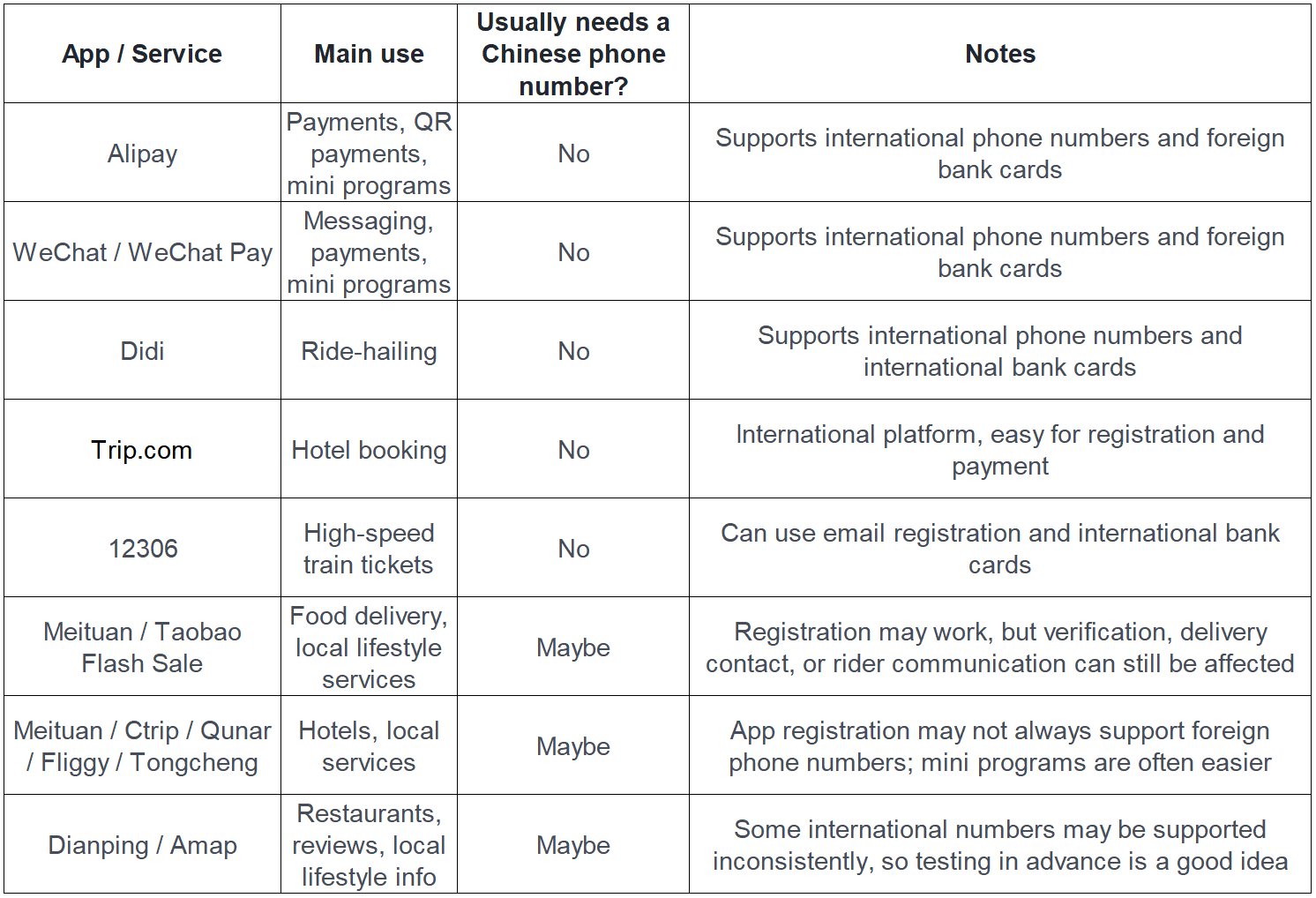
Alipay, WeChat, and Didi, etc., all support foreign numbers and international credit cards. You can ride the metro, hail a taxi, book hotels, and buy high‑speed train tickets without a local SIM. For food delivery or restaurant reviews, Meituan and Dianping sometimes require SMS verification from a Chinese number. However, you can often access their core functions through WeChat mini programs, which bypass standalone app registration.
If you do need a local number, the simplest route is to buy a Chinese SIM card at the airport upon arrival. The staff at Guangzhou Baiyun, Shenzhen Bao’an, and Nanning Wuxu airports are accustomed to foreign travelers and can set you up in minutes. Alternatively, if you are staying in Hong Kong first, a Hong Kong SIM with a mainland data package gives you the best of both worlds: a number for verification (Hong Kong numbers are accepted by many Chinese platforms) and unblocked internet.
5. Regional Tips for South China Travelers
South China’s geography and culture create unique connectivity scenarios. Here is how to handle them.
Guangdong and the Pearl River Delta: This urban cluster has excellent 4G/5G coverage everywhere. In Shenzhen and Guangzhou, you can rely on subway Wi‑Fi in stations, though it requires a Chinese phone number login. If you are crossing from Hong Kong to Shenzhen frequently, keep a Hong Kong SIM active, as you will drift between networks seamlessly.
Guangxi’s rural landscapes: In areas like Yangshuo and the Longji Terraces, signals can weaken in deep valleys. Download offline maps and content before leaving Guilin. Some rural homestays offer Wi‑Fi, but speed may only suffice for messaging, not streaming.
Hainan Island: Beach resorts and Sanya are well‑connected. However, if you venture to the volcanic island of Weizhou or remote coconut villages, a China Mobile SIM often holds a signal better than other carriers.
Hong Kong and Macau: These special regions have their own internet policies, with no firewall. You can freely access all global sites. A local SIM from Hong Kong works in Macau and often offers affordable roaming packages for mainland China, making it a clever base SIM for a South China multi‑city trip.
6. Into South China’s Connectivity Support
You can certainly sort out your SIM and VPN independently. But if you prefer a zero‑stress arrival, Into South China can pre‑arrange everything before you land. We advise on the best SIM or eSIM choice for your specific itinerary, help set up a Hong Kong SIM if you arrive via that route, pre‑install offline maps and translation packs, and provide a curated list of English‑friendly local apps tailored to South China. Our local team also monitors VPN reliability, so we can recommend the most stable service right before your trip. Our goal is to let you skip the digital headache and focus on the experience, exploring Guangdong’s cities, Guangxi’s karst peaks, or Hainan’s beaches with seamless connectivity.
Traveling to China without Google is not a crisis; it is a matter of preparation. With the right SIM, a VPN, and a handful of offline tools, you will stay connected, navigate with ease, and share every breathtaking moment from the Pearl River Delta to the Vietnam border. South China is ready for you; make sure your phone is too.