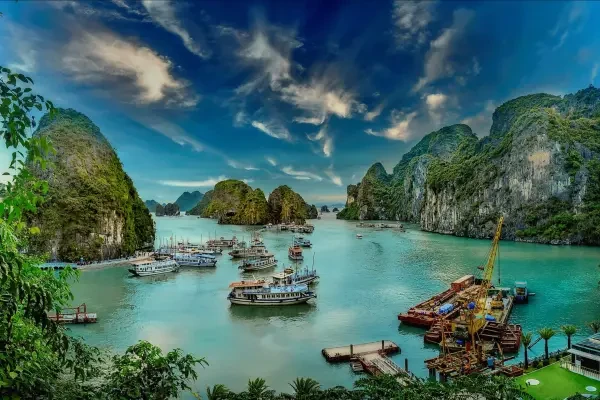
The Li River cruise is undeniably pretty, those limestone peaks rising from the mist like ancient ink-wash paintings, the water buffalo cooling themselves in the shallows. But pretty is not local. The local way to travel from Guilin to Yangshuo is to board the public ferry from Mopanshan Pier, a battered, two-deck vessel that has been making this journey for decades, carrying not tourists but farmers, market vendors, and families visiting relatives. Climb aboard with your backpack and find a spot on the hard wooden bench. Around you, the cargo is a living diorama of rural Guangxi: bamboo baskets woven with red ribbons, full of peeping ducklings; sacks of rice and sweet potatoes stacked waist-high; an old woman clutching a live chicken wrapped in newspaper, its head poking out with an expression of mild indignation. The four‑hour journey is slow, the engine a steady thrum, the air thick with the scent of river water and the occasional drift of cigarette smoke. Passengers share sunflower seeds from crumpled plastic bags, and the boatman brews tea in a large thermos, offering it to anyone who catches his eye. No one speaks English, but a smile is a passport.
You step off in Yangshuo, but you don’t go to West Street, the neon-lit backpacker strip of bars and souvenir shops. Instead, you squeeze into a shared minibus that rattles along narrow country roads, past pomelo orchards and fields of sugarcane. Forty minutes later, the bus drops you at the entrance of Jima Village, a settlement of a few dozen stone and brick houses nestled in a valley of emerald rice paddies, surrounded by a jagged amphitheatre of karst peaks. Here, Mr. Zhao, a wiry man in his sixties with a sun‑creased face and a shy grin, rents out two spare rooms in his family home. The rooms are simple: a firm bed draped with a mosquito net, a wooden stool, a window that opens onto a view of Elephant Trunk Hill’s quieter cousin, and the sound of a nearby stream.
Dawn Rituals and Rubber Boots
You wake at dawn not to an alarm, but to a rooster, a particularly enthusiastic one that seems to be stationed directly beneath your window. The morning light is soft and grey, the karst peaks still half‑hidden in mist. Mrs. Zhao, a woman of few words but immense warmth, appears at the kitchen door and hands you a pair of well‑worn rubber boots. They are caked with dried mud from a previous guest. You pull them on, and they fit surprisingly well.
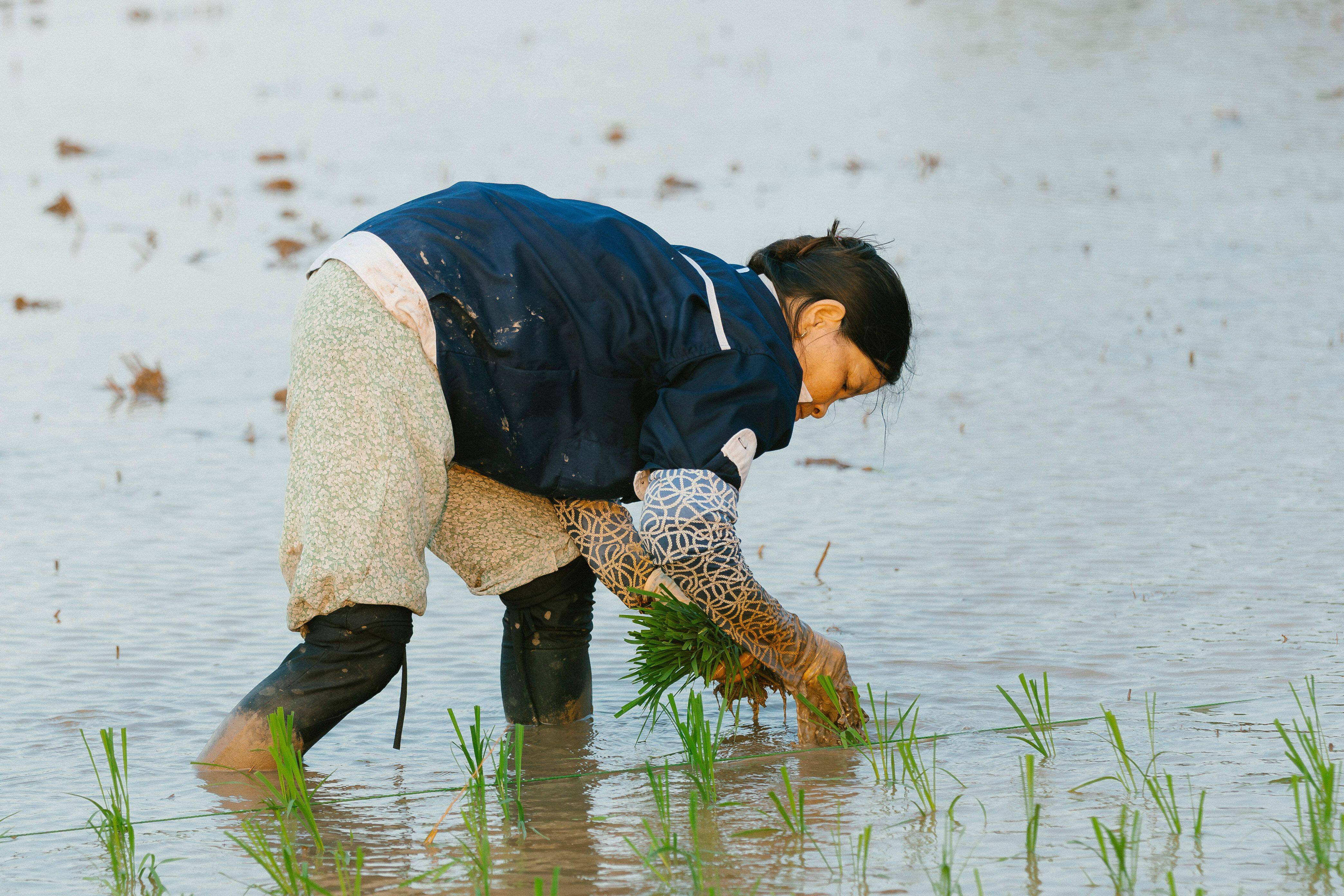
An adult woman bends over to plant rice seedlings in a flooded field, showcasing traditional farming methods
Today, depending on the season, you work. In spring, the paddies are being prepared, and you wade into ankle‑deep water to help plant rice seedlings. The mud squelches between your toes even through the boots, and you learn to bend at the waist, pushing each tender green shoot into the soft earth with a rhythm that is meditative once you find it. The other farmers, aunties in wide‑brimmed straw hats, their faces wrapped in colourful scarves, laugh gently at your technique and adjust your grip. In autumn, the work shifts to harvesting pomelos: you climb a short ladder propped against a tree heavy with the green‑gold fruit, twisting each one until it releases with a satisfying snap. The air is perfumed with citrus, and the ground beneath the trees is littered with fallen leaves and the occasional lazy gecko.
By mid‑morning, you will be tired in a way that feels deeply earned. Back at the house, Mrs. Zhao has been cooking while you worked. Lunch is served at a low wooden table set up in the open‑air courtyard, shaded by a trellis of grapevines. The food is farm‑to‑table in its most honest form: stir‑fried greens picked twenty minutes ago from the garden behind the kitchen, their stalks still crisp; a whole beer fish, the region’s signature dish, caught that morning from the village pond, braised with tomatoes, pickled chillies, and a splash of local beer, the flesh falling from the bone in silky flakes; and a small clay bowl of pickled mustard greens, sour and fiercely spicy, that makes your eyes water in the best possible way. Mr. Zhao pours tiny cups of rice wine, and you learn to say “Gānbēi”, bottoms up, before the burning warmth spreads through your chest. The family dog, a scruffy brown mutt named Little Yellow, rests his head on your knee, hoping for a fish bone.
Afternoon Wanderings and Karst Conversations
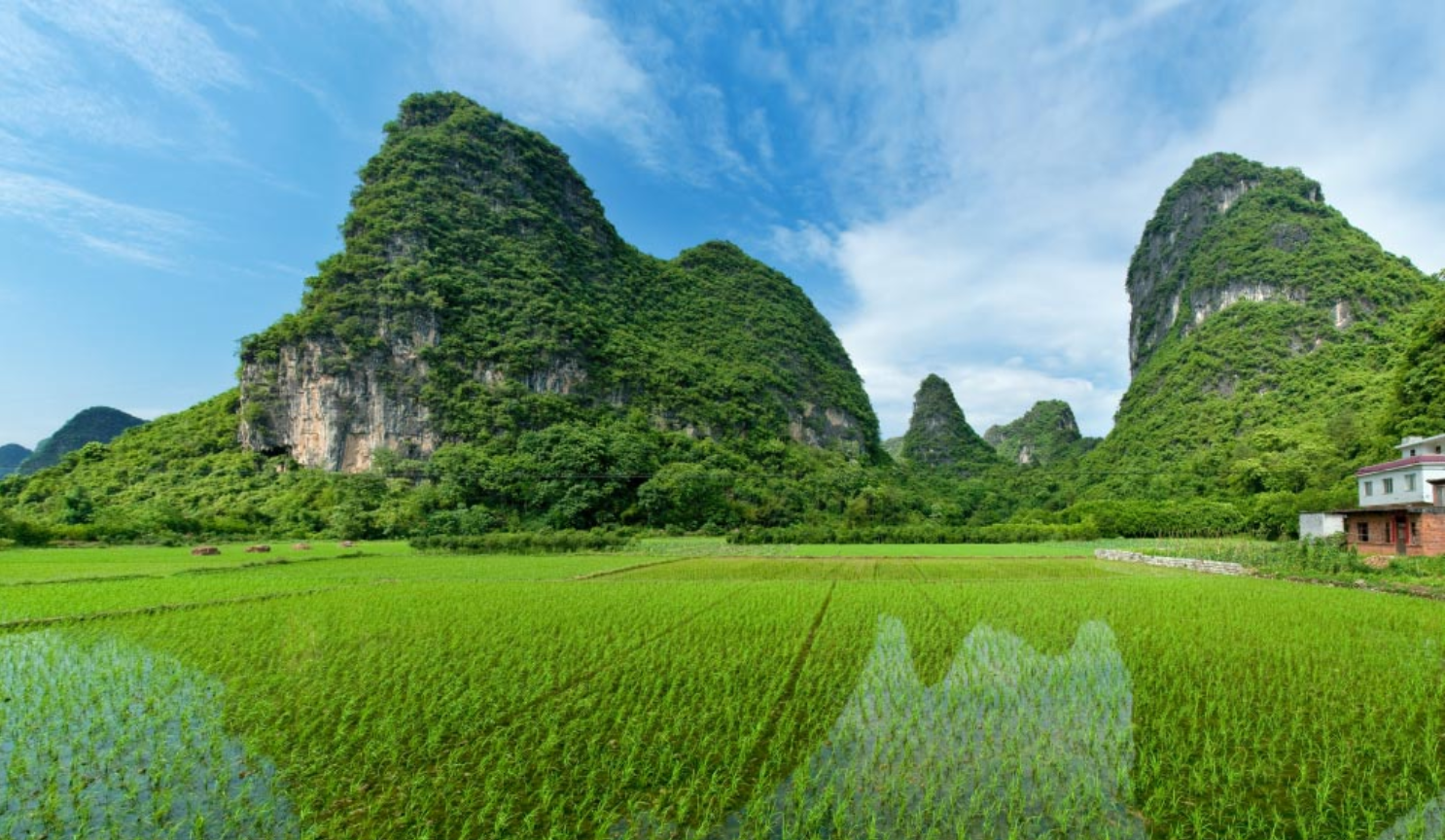
The flooded paddies, along with karst peaks and rare blue skies, provided an incredible opportunity to present this beautiful scene
In the afternoon, you borrow the family’s farm e‑bike, a sturdy, mud‑spattered machine with a battery that, improbably, still holds a full charge. The single‑track roads wind between rice fields that shimmer in the sun, the karst peaks rising on either side like a landscape painted on a scroll that unrolls as you ride. You pass water buffalo submerged to their nostrils in irrigation ponds, their eyes half‑closed in bovine contentment. You pass old stone bridges, their arches perfectly reflected in the still water below.
Your destination is Yulong Bridge, but not the tourist section with its bamboo rafts and loudspeakers. You ride to a quieter stretch, where the ancient stone steps descend into the river, and local women still wash clothes the way their grandmothers did, beating wet fabric against the flat rocks and gossiping in a dialect that rises and falls like birdsong. You sit on the bank, your boots off, feet dangling in the cool water. A farmer approaches; he might be seventy, or he might be a hundred, his face a map of a life outdoors. He offers you a cigarette from a crumpled pack. You don’t smoke, but you accept, holding it awkwardly between your fingers while he lights his own. He points a calloused thumb at a nearby peak. “That one,” he says in heavily accented Mandarin, “has a cave with bats. Many bats. At sunset, they fly out all at once, like a black river.” You make a mental note to return at dusk.
The farmer asks where you are from, and when you tell him, his eyes widen with distant recognition. He once knew a man from your country, he says, who came to teach English in Yangshuo fifteen years ago. The conversation is stilted, half words and half gestures, but you understand each other perfectly. Before he leaves, he pats you on the shoulder and says something that sounds like “Welcome to my home.” You realize that you have never felt more welcomed anywhere.
Evenings of Dust, Music, and Unexpected Kinship
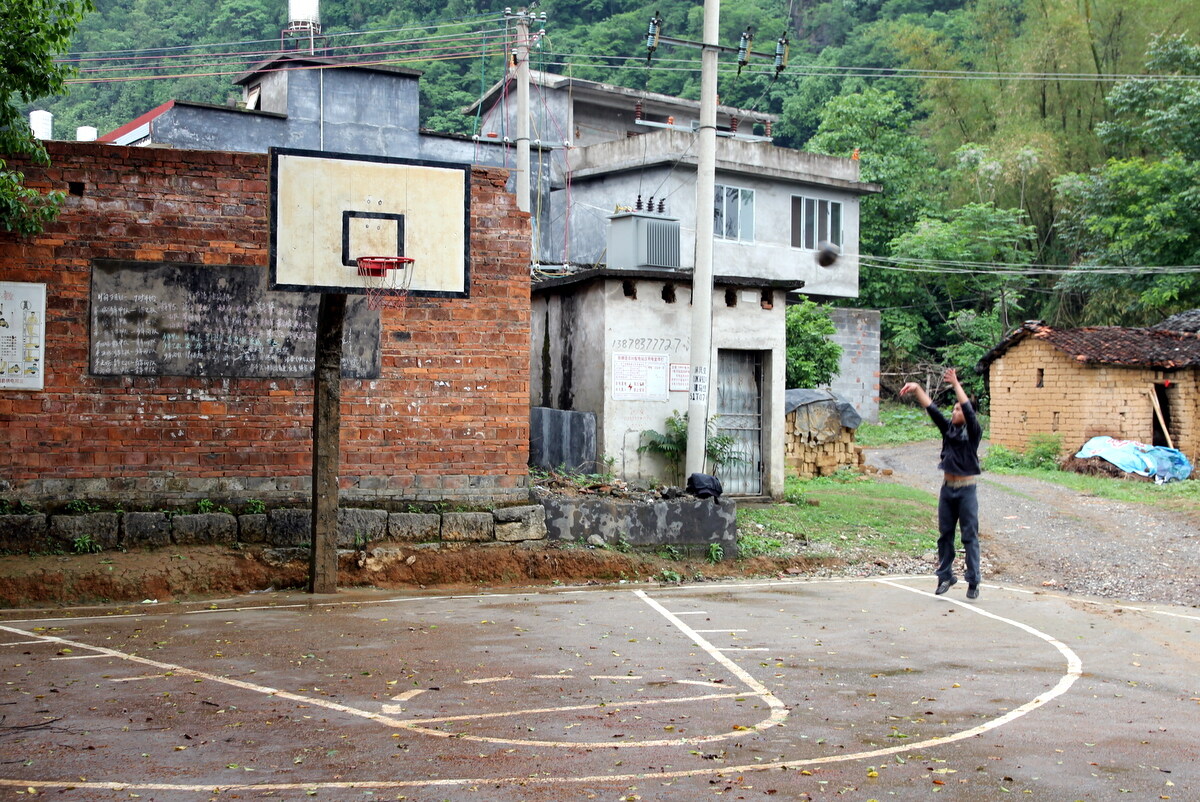
A traveller playing hoops in a village basketball court in Yangshuo
Dinner back at the Zhaos’ is another feast: perhaps a whole chicken, poached and then chopped through the bone with a cleaver, served with ginger‑scallion dipping oil and a bowl of the cooking broth, cloudy and restorative. After eating, you wander to the village basketball court, a patch of packed dirt with a hoop that is little more than a rusty rim nailed to a telephone pole, the backboard a warped piece of plywood faded by sun and rain. A group of village kids is already there, passing a half‑inflated ball. They spot you, and a game begins.
You are taller, but they are faster, and they have been playing on this uneven dirt since they could walk. They dribble around potholes with supernatural balance. You lose badly, your lungs burning from the effort and the laughter. The evening air fills with the rhythmic thud of the ball, the screech of delighted children, and the distant lowing of a water buffalo. After the game, a boy of about ten, the team’s star player, offers you a piece of sugarcane from his pocket, already peeled and split lengthwise. You chew the sweet fibrous pulp, juice running down your chin, and feel something unclench in your chest that you didn’t know was tight.
Later, back at the house, Mr. Zhao brings out his erhu, a two‑stringed Chinese fiddle, and plays a melody that is all aching bends and quivering vibrato. The notes float out into the night, over the rice paddies, toward the karst peaks silhouetted against a sky thick with stars. His wife hums along softly. You sit on the doorstep, a cup of jasmine tea warming your palms, and think: this is not a tour. It’s a trade, your curiosity for their hospitality. And it’s waiting for you in Guangxi.
Your Gateway to the Karst Countryside
This kind of travel, deeply personal, entirely unscripted, can feel out of reach if you don’t speak the language or know where to start. That’s where Into South China steps in. We arrange homestays like Mr. Zhao’s in villages across Guangxi, matching you with families who are genuinely eager to welcome you into their daily rhythms. We provide the rubber boots and the e‑bike, the private transfer from Guilin, and a bilingual cultural guide who can translate both the words and the unwritten customs: why you should accept that offered cigarette, how to properly toast with rice wine, when to bow slightly and say “thank you” with two hands. Our itineraries are completely flexible: spend one night or a full week, add a cooking lesson or a calligraphy session, pair your village stay with the Impression Liu Sanjie show or a Li River bamboo raft at sunrise. You bring curiosity and an open heart; we handle every detail, including onward travel to your next South China destination. Contact us to begin your slow‑living journey through the rice‑field villages of Guangxi, where time moves at the pace of a water buffalo, and every stranger can become a friend by sunset.
Client Review
"The karst landscapes of Guilin and Yangshuo took our breath away! Cycling through rice paddies with limestone peaks towering above, bamboo rafting on the Li River at sunrise, and watching cormorant fishermen at dusk – it felt like living inside a traditional Chinese painting. The rural countryside experience was pure magic."
Trip Highlights
- ✓
Li River Bamboo Rafting
83km journey through karst wonderland, Nine Horse Fresco cliff, Yellow Cloth Reflection – immortalized in poetry and art for centuries
- ✓
Yangshuo Countryside Cycling
Ride through rice paddies and karst peaks, visit Moon Hill, watch traditional cormorant fishing demonstrations at sunset
- ✓
Liu Sanjie Light Show
Zhang Yimou's spectacular outdoor performance on Li River waters with illuminated karst peaks as natural backdrop
- ✓
Reed Flute Cave Exploration
Magnificent underground palace of stalactites and stalagmites, lit with colorful lights creating fairy-tale atmosphere