When international travelers picture Guangxi, they instantly imagine sharp, tower-shaped green peaks rising from winding rivers and lush farmland. This breathtaking scenery is the world's most spectacular example of karst topography, a landscape sculpted not by sudden geological violence, but by water patiently dissolving limestone over millions of years. What most visitors never realize, however, is that these mountains are far more than a photogenic backdrop. They are an invisible architect that has dictated where people live, how they farm, what they eat, and even how they sing. The karst landscape and the human culture layered upon it are inseparable, two threads of a single story. Understanding that connection transforms a scenic boat ride into a profound encounter with a living, adaptive civilization.
How Water Eats Rock: The Karst Recipe Made Simple
Most geology textbooks bury this story under chemical formulas, but the process is intuitive. Imagine a vast, thick bed of limestone laid down by ancient seas hundreds of millions of years ago. Now picture Guangxi's subtropical climate: warm, heavy with rain, and blanketed in vegetation. As raindrops fall through the atmosphere and seep through decaying leaves on the forest floor, they absorb carbon dioxide and turn mildly acidic, no stronger than lemon water. Over eons, this weak acid seeps into microscopic cracks in the limestone, dissolving the rock grain by grain, widening fissures, and carrying dissolved minerals away.
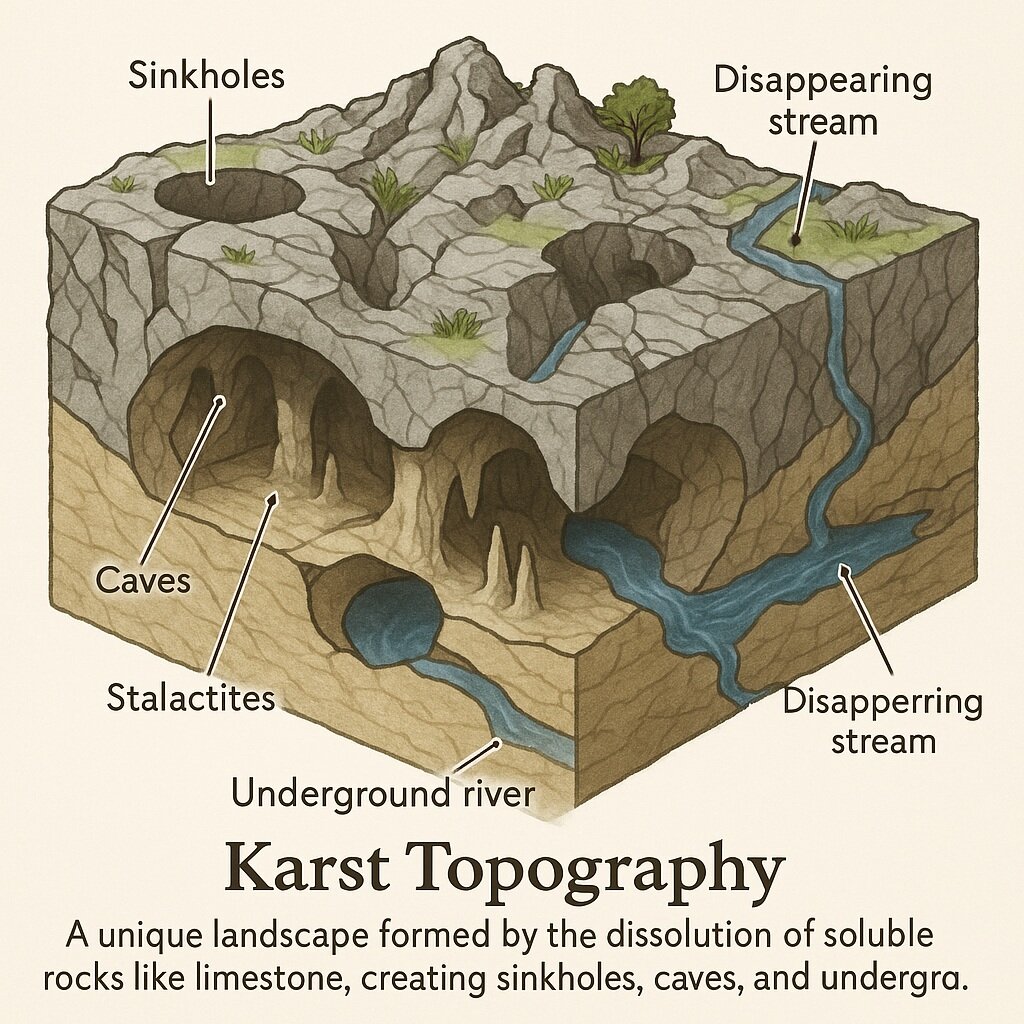
On the surface, this uneven dissolution leaves behind isolated pinnacles, steep-walled valleys, and sinkholes, the iconic tower karst that lines the Li River and the countryside around Yangshuo. Underground, the same process hollows out immense caverns, carves subterranean rivers, and drips dissolved calcite into stalactites and stalagmites over tens of thousands of years, forming show caves like Reed Flute Cave near Guilin. Guangxi's extraordinary combination of thick limestone and heavy seasonal rainfall produced the largest continuous karst landscape on Earth, now recognized as a UNESCO World Natural Heritage Site. The stage was set. Then people arrived, and the real story began.
Living with an Uneven Hand: How Karst Dictated Daily Life
For the Zhuang, Yao, and Han villagers who settled this region centuries ago, the karst terrain was both a gift and a demanding master. Its thin, patchy soil and leaky hydrology meant that conventional farming was impossible. Survival required adaptation, and adaptation created a way of life so intimately tied to the limestone that it became cultural DNA.
Settlements and Shelter
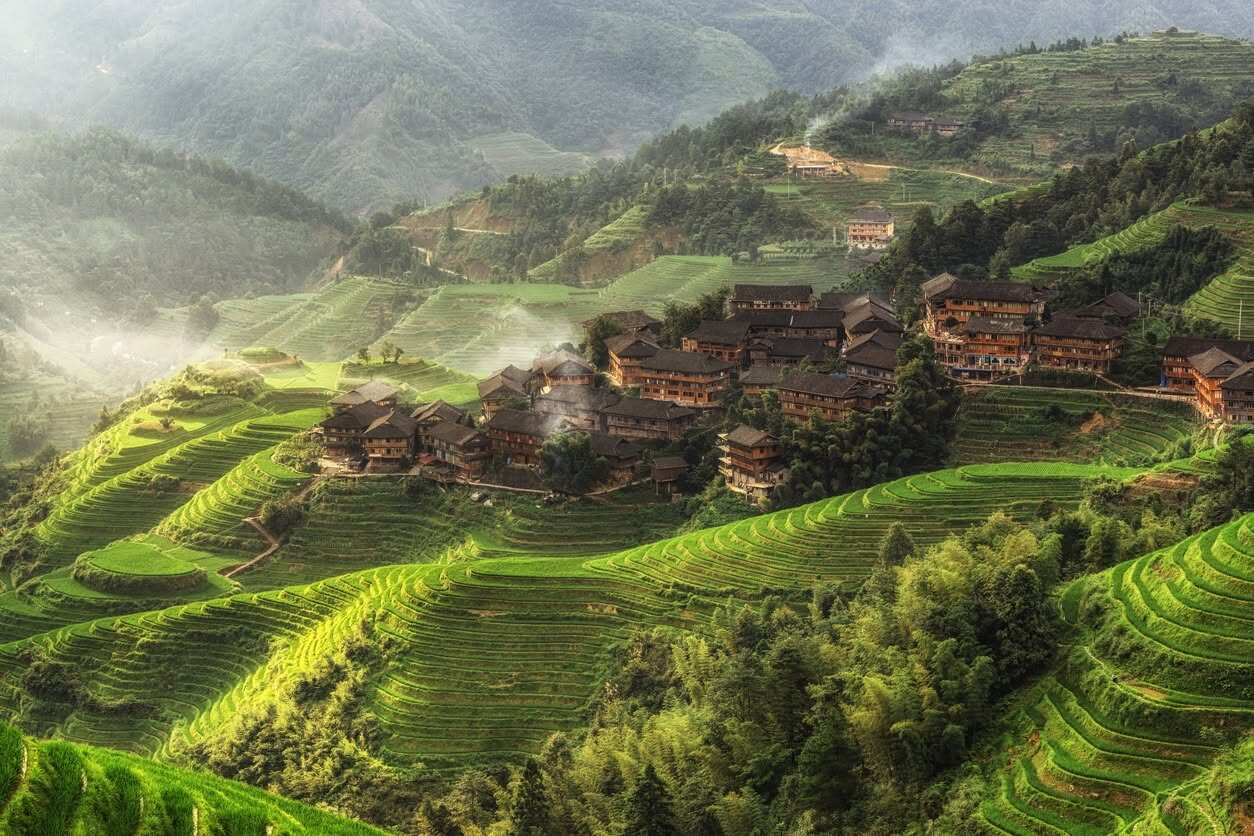
Longsheng Rice Terraces preserve centuries of living heritage
In karst country, flat land is precious, and flooding is a constant threat in valley bottoms during the rainy season. Villagers learned to build their homes on gentle hillsides, leaving the fertile, level ground entirely for crops. The classic "high house, low farm" layout, villages perched above the fields, is a direct response to this terrain. Traditional diaojiaolou (stilted wooden houses) lift living spaces above the damp, snake-prone ground, their designs refined over generations to handle the humid microclimate trapped between limestone walls.
Farming the Impossible
Karst soil drains like a sieve. Rainwater vanishes into underground fissures, leaving crops parched on the surface. Zhuang farmers invented layered solutions: terraced rice paddies sculpted into hillsides to catch and hold rainwater, and valley-bottom fields irrigated by spring-fed channels that intercept groundwater before it disappears. The rice-fish-duck symbiotic system, still practiced today, maximizes every square meter of arable land: rice provides shade and habitat, fish control pests, and ducks stir nutrients. Stone cisterns, hand-carved into hillsides to store seasonal rain, remain a vital lifeline for villages far from permanent rivers.
The Sound of Mountains
Walk through a karst valley at dusk, and you may hear a voice floating across the peaks. The limestone towers, hard and steep, create natural acoustic resonance. For centuries, Zhuang villagers used this to their advantage, singing antiphonal folk songs that could carry a courtship invitation or a harvest announcement from one isolated hamlet to another. The legendary Liu Sanjie, the "Song Fairy" of Guangxi, is not a myth; she is a distillation of this real practice, born directly from a landscape where shouting was impractical, but singing could bridge distance with beauty. Her culture survives in village song festivals, and the magnificent Impression Liu Sanjie light show on the Li River.
Community and Cooperation
Steep mountain paths once made single-family survival nearly impossible. Building a house, digging an irrigation ditch, or constructing a covered "wind-and-rain bridge" demanded collective effort. Neighbors helped neighbors, forging tightly knit clan communities with strong mutual-aid values that persist. Weekly rural market days remain as much social rituals as commercial ones: farmers arrive not just to trade rice and pomelos, but to linger for hours in conversation, reinforcing bonds that the terrain demanded generations ago.
Sacred Spaces
For these communities, the karst landscape is alive. Deep caves, ancient banyan trees, and perennial springs are regarded as dwelling places of spirits. Seasonal rituals thank mountains and waters for fertile soil and steady flow. Ancestral tombs are often sited on quiet hillsides overlooking karst valleys, embedding family memory directly into the limestone. This is not abstract superstition; it is a vocabulary of gratitude and caution, developed by people who understood that their survival depended on harmony with a landscape that could easily starve them.
Diving Deeper with Into South China
Most tourists see the Li River from a cruise deck and leave with only a surface impression. To genuinely understand how karst has shaped local identity, you need to slow down, step off the boat, and live inside the landscape. That is where Into South China's cross-cultural, English-guided experiences open doors that independent travelers rarely find.
We don't just show you the peaks. We arrange village homestays with Zhuang families in Yangshuo or the Mingshi Pastoral Area near the Vietnam border, where you'll wake to roosters, pull on rubber boots, and help your host tend rice paddies or pick wild mountain vegetables. You'll cook a meal together, using ingredients sourced from the karst hills and rivers, and learn recipes passed down through generations who adapted their cuisine to what the limestone could offer.
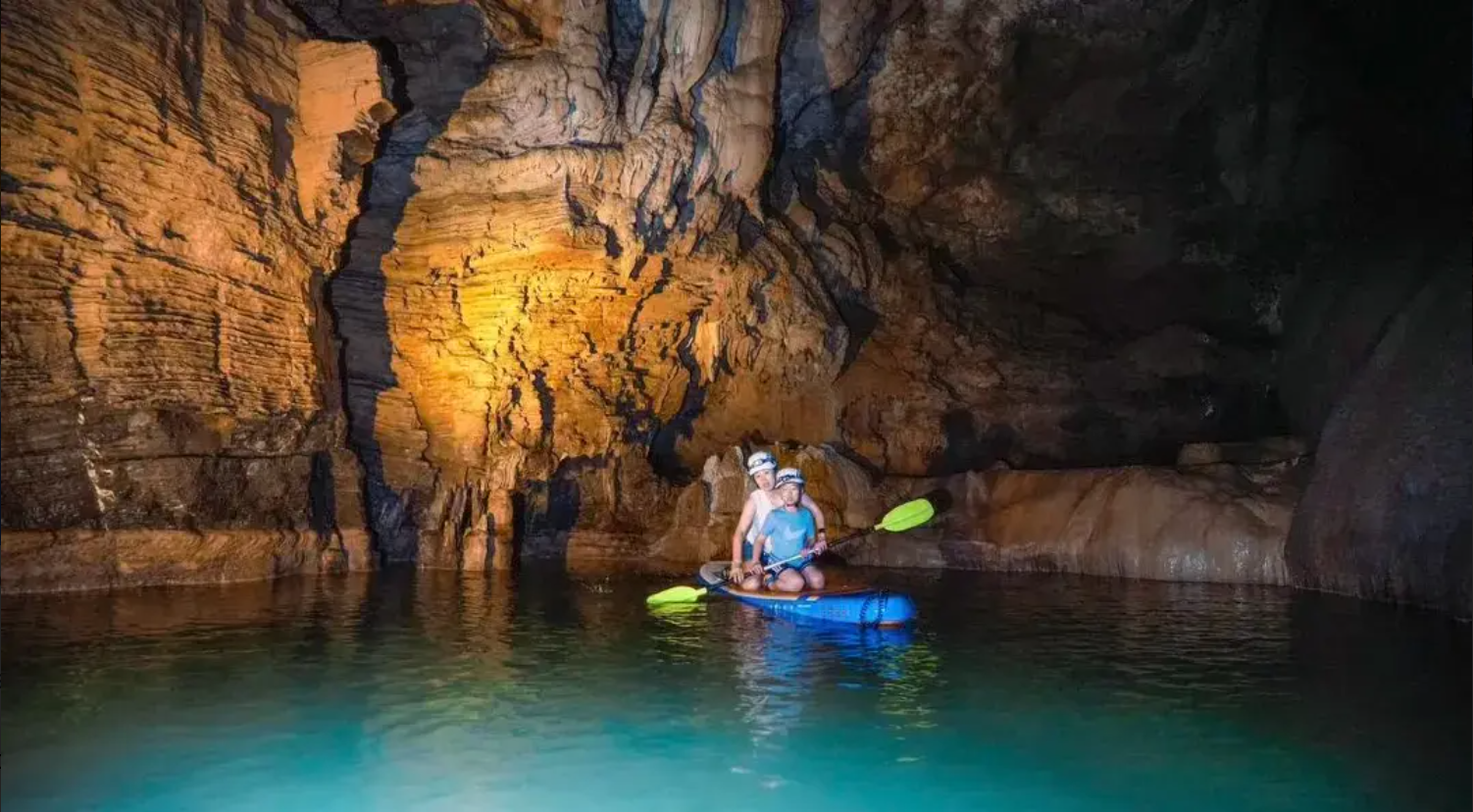
Paddle beneath layered limestone rock walls on a one-of-a-kind subterranean adventure hidden in South China’s karst wonderland
For the curious, we offer hands-on workshops: learn Zhuang embroidery patterned after mountain and river motifs, weave bamboo crafts using local bamboo, or sit with a folk singer who will teach you a simple antiphonal song, explaining how the melody's shape was once a practical tool for long-distance communication across valleys. For the adventurous, we guide you through illuminated show caves with geological interpretation that makes stalactite timelines tangible, and, if you're game, take you on a shallow wild cave hike to see raw karst erosion features that no ticket booth covers.
As dusk falls, we arrange a bamboo raft ride with elderly cormorant fishermen who still practice the ancient fishing method adapted to rocky riverbeds. They'll share oral histories that connect river livelihoods to the karst water system. You can also cycle quiet country lanes winding between peak clusters, observing the high-house-low-farm pattern and ancient stone cisterns up close, with a guide who links what you see to the geography that shaped it.
Our guides are trained differently. They don't just recite facts about scenic spots. They connect every landscape to the farming, housing, and folk tradition logic behind it. They arrange visits to villages inaccessible to independent travelers, bridge the language gap with elderly villagers, and design multi-day bleisure itineraries across Guilin, Yangshuo, and Chongzuo that blend karst sightseeing with genuine cultural immersion.
The Landscape and the Life Are One
Guangxi's karst landscape is far more than a postcard. It is a slow, quiet sculptor that carved limestone into peaks over millions of years, then carved the survival wisdom of entire communities into those same contours. When you walk its rural valleys, talk with its people, and taste food grown in its thin soil, you begin to grasp an inseparable bond between geology and humanity.
With Into South China, you won't just see beautiful mountains and rivers. You'll feel how a landscape can shape a culture, and leave with an understanding of Guangxi that remains long after the photographs fade.