
For cycling enthusiasts who crave something beyond the ordinary, the Greater Bay Area offers a truly unique challenge: the chance to ride through three of Asia's most dynamic cities, Hong Kong, Shenzhen, and Macau, in a single journey. This is not a tour for the casual cyclist. It is a multi-day adventure that demands fitness, preparation, and a spirit of exploration. The route takes you from Hong Kong's leafy New Territories greenways, across the border into Shenzhen's spectacular coastal boardwalks, down to the sleek new Hengqin border crossing, and finally into the charming streets of Macau. Along the way, you will experience the contrasting personalities of the Greater Bay Area: Hong Kong's disciplined infrastructure, Shenzhen's ambitious coastal development, and Macau's Portuguese-colonial charm, all from the saddle of a bicycle. This journey is designed for experienced cyclists only. It involves long distances, challenging road conditions, complex border crossings, and significant physical demands. But for those who are prepared, it offers an unforgettable immersion into the region's diverse landscapes, cultures, and culinary traditions.
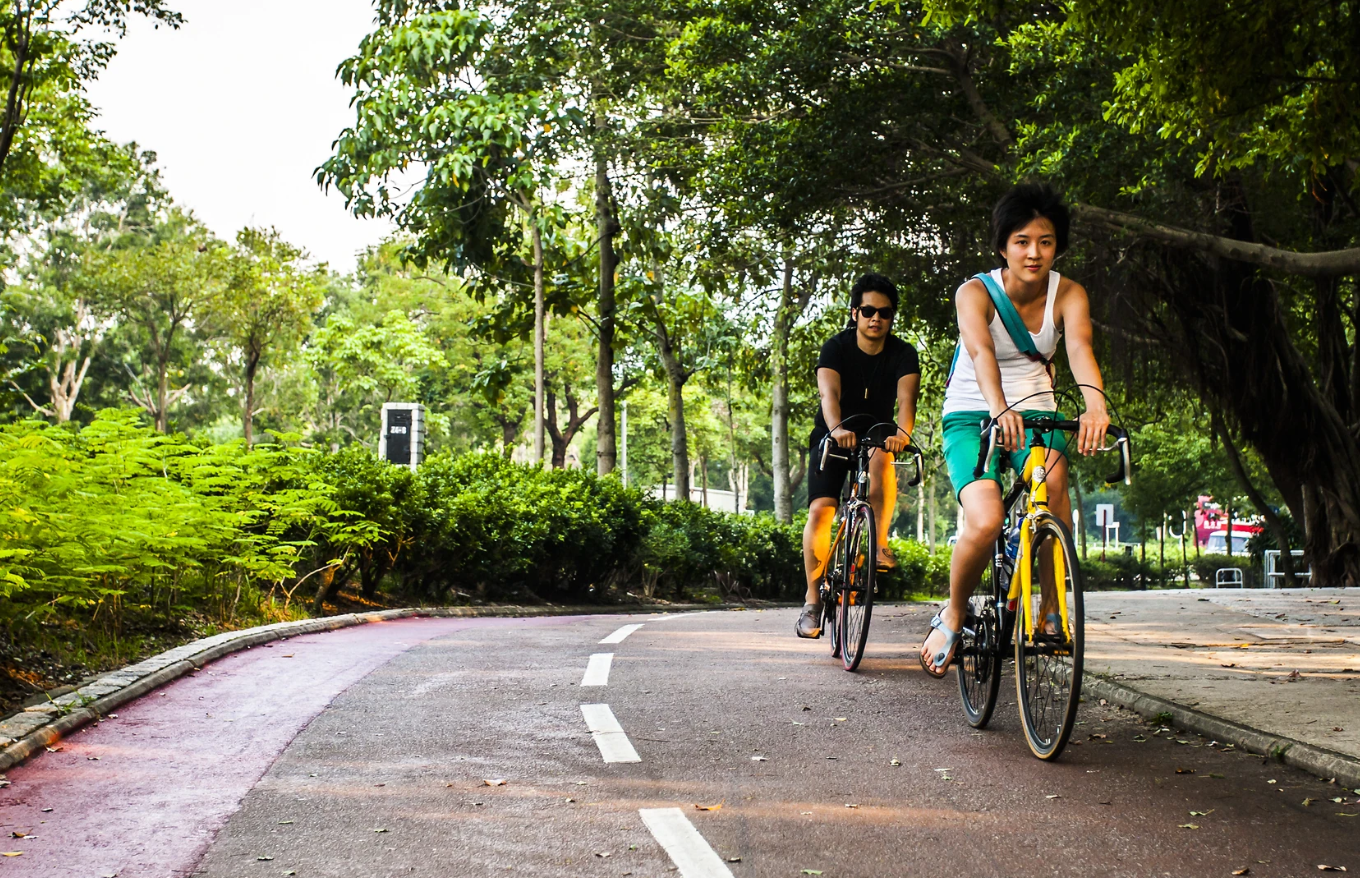
The Tai Wai/Sha Tin to Tai Po route is probably Hong Kong’s most picturesque cycling route
The adventure begins in Hong Kong's New Territories, a region of villages, wetlands, and coastal views that most visitors never see. The classic route from Sha Tin to Tai Mei Tuk takes you along the Shing Mun River, past the gleaming glass towers of the Hong Kong Science Park, and through the expansive Tai Po Waterfront Park. The ride ends at Tai Mei Tuk, a charming fishing village at the end of a long dam, where seafood restaurants and sunset views over Tolo Harbour await. The total route is about 22 kilometers one way, roughly three hours at a moderate pace, though more ambitious cyclists can extend the ride to 60 kilometers by continuing west through Fanling and Sheung Shui toward Yuen Long and Tuen Mun. But caution is essential: while Hong Kong's cycling paths are separated from vehicle traffic in many areas, most sections require sharing the road with cars that move fast on narrow roads. After Tai Mei Tuk, cycling is prohibited on a steep section leading toward Luk Keng, where riders must dismount and push their bikes. The New Territories also offer gentler alternatives: the Yuen Long Bicycle Path winds through villages and past wetlands, while the Tolo Harbour Loop offers a longer coastal journey with spectacular views.
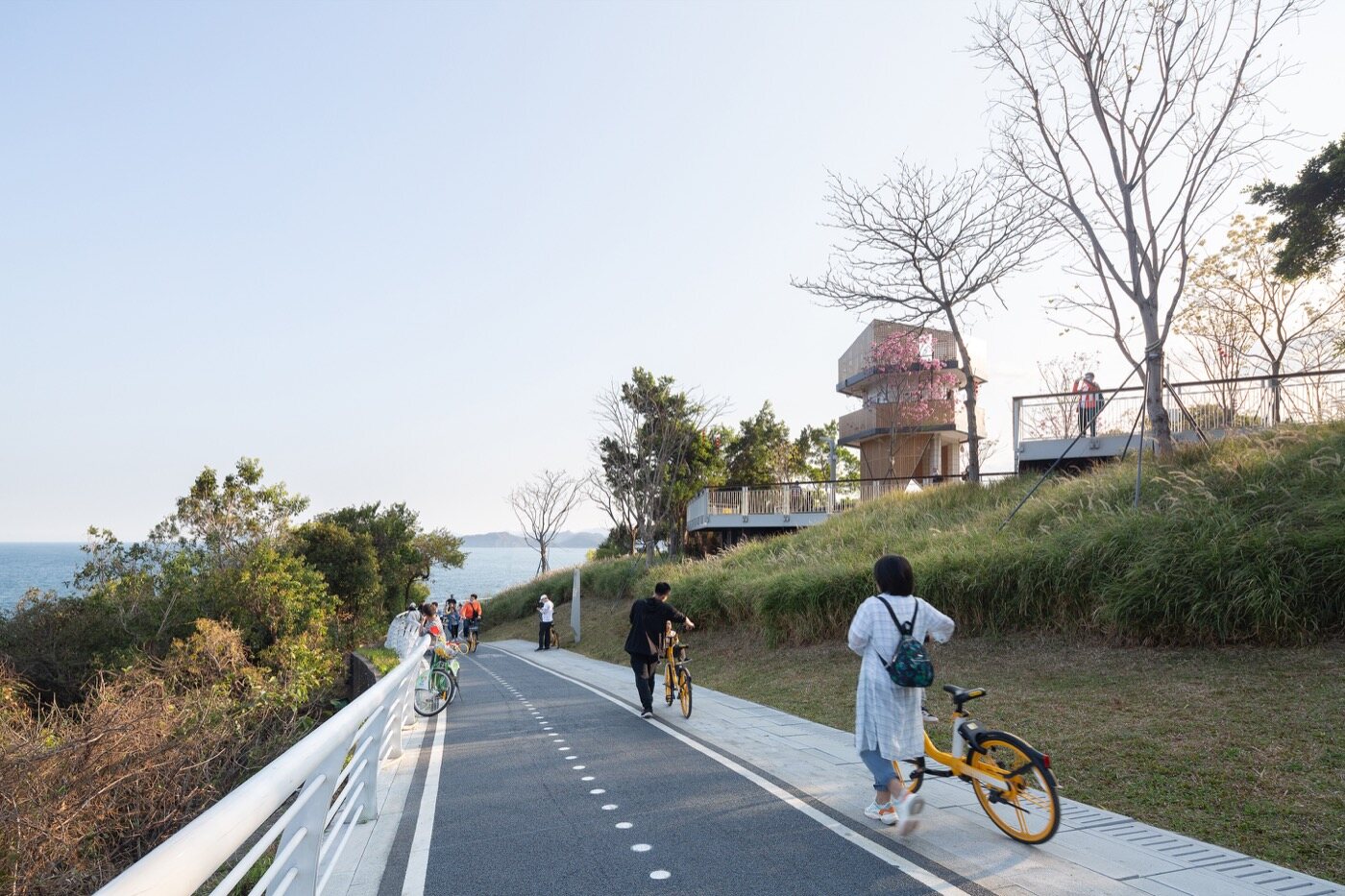
Yantian Waterfront Boardwalk in the eastern part of Shenzhen is famous for its spectacular ocean views
Crossing from Hong Kong into mainland China is an experience in itself. The Liantang Checkpoint is one of the newer border crossings, with modern facilities and relatively light traffic compared to the busy Lo Wu or Lok Ma Chau crossings. When crossing with a bicycle, you must use the manual channels; the automatic gates are too narrow for bikes, and border staff may ask you to lift your bike to clear the sensors. Once through, you enter Shenzhen, a city that boasts over 3,400 kilometers of greenways, with some of the most spectacular along its eastern coastline. The Yantian Coastal Boardwalk is a purpose-built cycling path that runs for approximately 19.5 kilometers from Zhongying Street to Beizaijiao Lighthouse. This mostly flat route offers a dramatic 270° ocean view, passing the forest of cranes at Yantian Port, one of the world's busiest container ports, and the popular beaches of Dameisha and Xiaomeisha, before ending at a dramatic coastal viewpoint. The boardwalk is a relaxing ride after the exertion of the border crossing, with the sea breeze and open views providing a welcome contrast to the urban intensity of the crossing.
From Shenzhen, the journey continues by high-speed train to Zhuhai, a journey of approximately two hours during which bicycles must be folded or disassembled and placed in a bag as oversized luggage. From Zhuhai, the gateway to Macau is Hengqin Port, which offers a smoother, less crowded border experience compared to the bustling Gongbei Port. The roads leading to the port are wide and flat, perfect for cycling. Crossing with a bike again requires using the manual channels, and cyclists should note that a bridge connects Hengqin to Macau's Taipa; cycling on this bridge is not permitted. Instead, you will need to fold or disassemble your bike and take the free shuttle bus across. Once in Macau, the exploration begins on Taipa Island, home to the glittering Cotai Strip, the charming Rua do Cunha food street with its famous Portuguese egg tarts, and the pastel-yellow Our Lady of Carmo Church. The University of Macau offers a stunning modern campus worth photographing, and the Cotai Strip itself is a spectacle of casino resorts that rival Las Vegas. Crossing from Taipa to the Macau Peninsula requires crossing the Governor Nobre de Carvalho Bridge, but cycling is not permitted on this bridge; you must dismount and push your bike across.
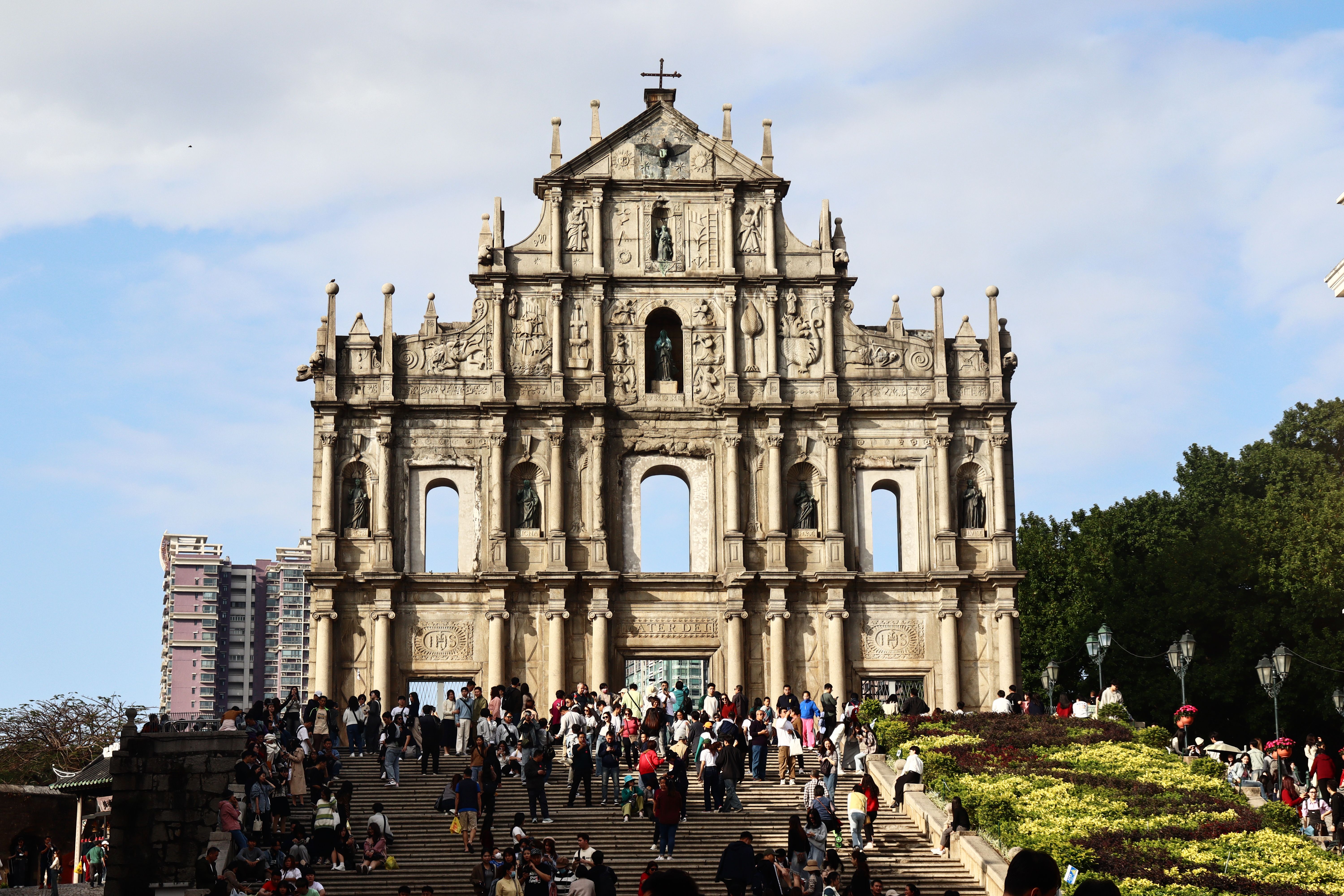
Vibrant crowd visits the ruins of St. Paul's, a renowned Macau landmark
Macau's peninsula is compact but hilly, and the best way to explore its historic center is to leave your bike at your hotel and walk. The streets are steep, crowded, and not designed for cycling. Walking highlights include the Ruins of St. Paul's, Macau's most famous landmark, a 17th-century church facade that has become the city's icon, Senado Square with its wave-patterned plaza surrounded by pastel Portuguese buildings, Largo do Lilau with its quiet fountain and colonial charm, and St. Dominic's Church, a baroque masterpiece from the 16th century. For those with energy to spare, Macau's Southern Coastal Promenade recently opened a new section with over 600 meters of dedicated cycling paths between the Governor Nobre de Carvalho Bridge and the Kun Iam Statue. But cyclists in Macau must remember to ride on the left, as Macau drives on the left like Hong Kong and the UK, and never ride on the pavement; you must walk your bike or risk a fine. Buses and casino shuttle buses do not accept bicycles, and while taxis can accommodate folded bikes, they cannot carry full-sized bicycles.
Beyond the ride itself, several crucial considerations demand attention. The visa requirements for this route are complex. Many nationalities enjoy visa-free entry to Hong Kong for stays of 7 to 180 days, and Macau offers visa-free entry to many nationalities for stays of 30 to 90 days. However, entering mainland China requires a visa for most foreign nationals. Fortunately, many nationalities qualify for China's 240-hour visa-free transit policy when entering through designated ports in Guangdong, including Shenzhen Bao'an Airport and the Hong Kong West Kowloon Railway Station. This policy allows stays of up to 10 days across 24 provinces. However, to qualify, you must hold a confirmed onward ticket to a third country or region, not back to your origin, within 240 hours. If you are flying directly from Hong Kong back to your home country after Macau, this qualifies as an onward journey. But if you are flying from Macau back to the country you departed from, you may not qualify. Consultation with Into South China is strongly recommended for personalized visa guidance.
The physical demands of this route should not be underestimated. Covering 90 to 120 kilometers over multiple days, with some segments on busy roads, this journey is not suitable for casual cyclists. The region's subtropical climate means temperatures can exceed 30°C with high humidity, and rain is common. Traffic rules are inconsistent: Hong Kong and mainland China drive on the right, while Hong Kong and Macau drive on the left, a constant demand on your attention. Border crossings require patience, and full-sized bicycles are not allowed on Macau buses or casino shuttle buses. Proper equipment is essential: a helmet, front and rear lights, reflective clothing, a repair kit, spare inner tubes, a pump, and a lock are all recommended. Into South China can assist with renting quality bicycles in Hong Kong, Shenzhen, or Macau, and can arrange pick-up and drop-off logistics.
Travel insurance that covers cycling accidents and medical evacuation is strongly recommended, as some policies exclude cycling; read the fine print. Into South China can advise on suitable coverage. For those who prefer extra support, a support vehicle for luggage transport and emergency backup is available through Into South China. While Hong Kong and Shenzhen are largely cashless, Macau still relies on cash in smaller shops; carry Macanese pataca for street food and local markets. English is widely spoken in Hong Kong and Macau, but in Shenzhen, basic Mandarin phrases will help, and a translation app is recommended. Carry at least 2 liters of water per day, refilling at convenience stores along the route.
This is not a tour for the unprepared. It involves border crossings, complex logistics, and physical challenges that demand professional coordination. Into South China specializes in creating bespoke cycling experiences across the Greater Bay Area, offering visa consultation to help you navigate the 240-hour visa-free transit policy and ensure your documentation is in order, equipment coordination to arrange bike rental, delivery, and pick-up so you don't have to carry your own, support vehicle options for luggage transfer and emergency backup, and experienced local guides who know the routes, the traffic patterns, and the best places to stop. Border assistance smooths the crossings so you can focus on the ride, not the paperwork.
This is a journey for cyclists who crave something different, a ride that weaves through three distinct cities, across two borders, and along some of the most spectacular coastline in Asia. It demands preparation, fitness, and respect for the road. But for those who are ready, it offers an experience no train or car can replicate: the feel of the wind in your face as you roll from Hong Kong's villages to Shenzhen's boardwalks to Macau's colonial streets. Contact Into South China today to start planning your Greater Bay Area cycling adventure. The road is calling. Are you ready to answer?
Client Review
"An unforgettable journey through South China's most breathtaking landscapes and cultural treasures. Every detail was perfectly arranged, from authentic local experiences to comfortable accommodations. Highly recommended for travelers seeking genuine immersion!"
Trip Highlights
- ✓
Authentic Local Experiences
Immerse yourself in daily life, culture, and traditions of South China
- ✓
Scenic Natural Wonders
Breathtaking landscapes from karst peaks to tropical beaches
- ✓
Culinary Discoveries
Taste regional specialties and authentic local flavors
- ✓
Cultural Heritage Sites
Explore ancient temples, historic architecture, and UNESCO sites


