Most first-time learners and travelers associate Chinese with Mandarin, China’s official and nationwide common language. However, China boasts extraordinary linguistic diversity, with a variety of regional dialects that carry unique local histories, traditions, and cultural identities. Among all Chinese regional languages, Cantonese enjoys the strongest global influence, deeply rooted in international pop culture, overseas diaspora communities, and cross-border exchanges. To fully understand Cantonese and its unique charm, we first break down China’s overall linguistic landscape and the origin of Mandarin.
The Rise of Mandarin: China’s National Official Language
Mandarin (officially named Putonghua) originates from northern Chinese dialects, with the Beijing dialect as its core foundation. For centuries, northern dialects served as the standard language for ancient Chinese imperial courts and official administrative affairs. After the establishment of modern China, the government officially standardized Beijing-based Mandarin as the national universal language. It has been widely promoted across education, media, business, and public services to bridge regional language gaps and unify national communication. Today, over 90% of Chinese people speak Mandarin, making it the dominant language for daily domestic life, formal education, and international diplomacy.
Major Regional Chinese Dialects
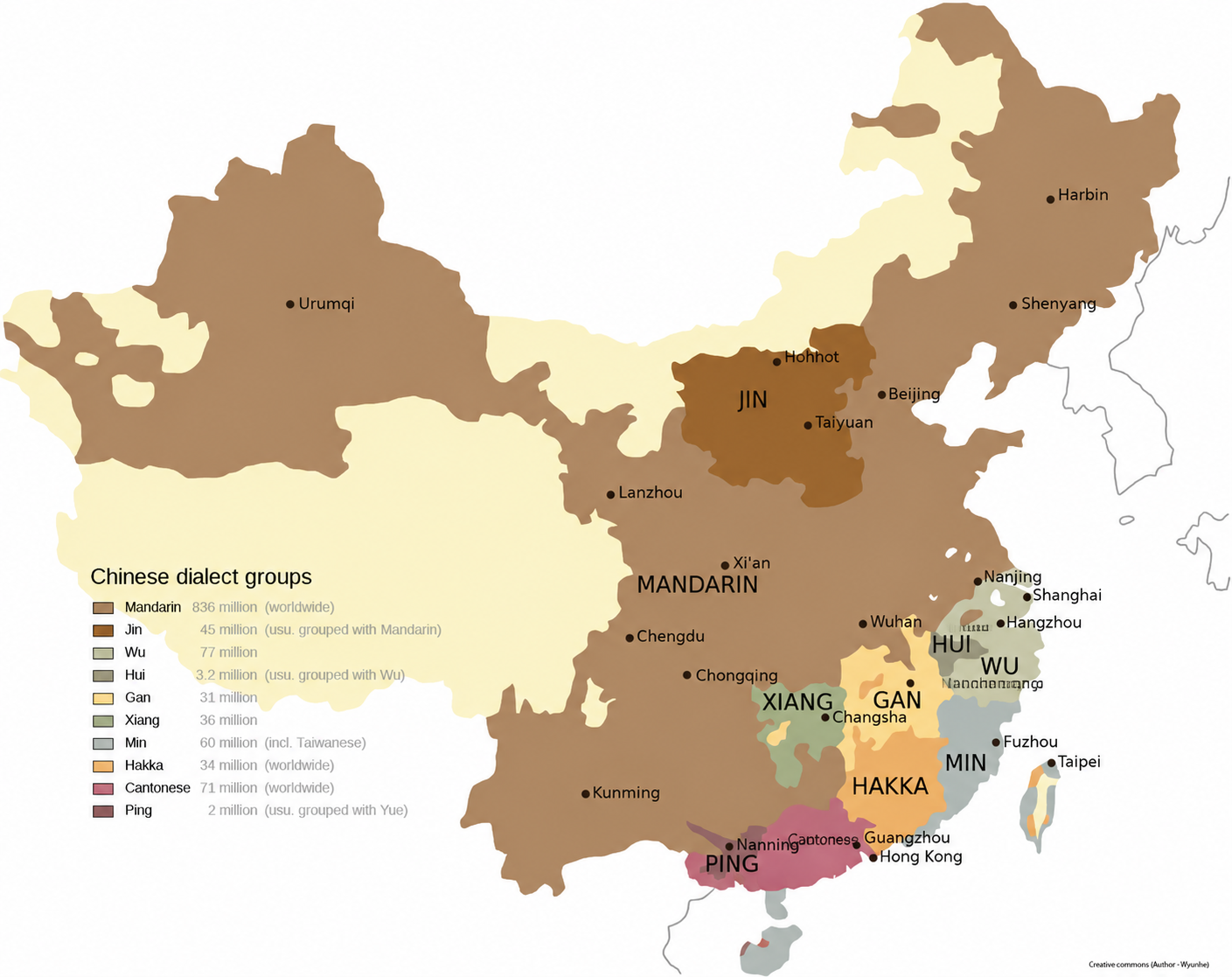
Explore the diversity of Chinese language dialects
While Mandarin unifies the whole country linguistically, China preserves seven major traditional dialect families. These are far more than simple accents; each features an independent phonetic system, exclusive vocabulary, and distinct cultural connotations, differing greatly from standard Mandarin. The seven mainstream Chinese dialect groups are listed below:
Mandarin Dialects (Northern Dialects): The largest dialect group, covering most of northern, central, and western China, with high consistency and strong universality.
Wu Dialect: Spoken in Shanghai, Jiangsu, and Zhejiang regions, known for its soft, gentle tone.
Min Dialect: Popular in Fujian and Taiwan, featuring complex phonetics and diverse sub-branches.
Cantonese (Yue Dialect): Dominant in South China, including Guangdong, Guangxi, Hong Kong, and Macau, the most internationally renowned Chinese dialect.
Hakka Dialect: A traditional migrating dialect widely distributed across South China’s mountainous areas.
Xiang Dialect: Native to Hunan Province, with a bold and distinctive pronunciation.
Gan Dialect: Mainly used in Jiangxi Province, with unique local phonetic features.
The Origin & Unique Features of Cantonese
Cantonese (also referred to as the Yue dialect) took shape in China’s Lingnan region, covering present-day Guangdong, Guangxi, Hong Kong, and Macau. Unlike northern dialects, which have undergone continuous simplification and evolution alongside dynastic changes, Cantonese well preserves authentic phonetics, vocabulary, and grammar from the Tang and Song dynasties, representing the essence of the ancient Chinese language. For thousands of years, Lingnan’s mountainous terrain formed a relatively isolated geographical environment, allowing Cantonese to maintain its complete ancient linguistic characteristics without being heavily assimilated by northern Mandarin.
Cantonese has distinctive traits that set it apart from modern Mandarin, making it uniquely charming and easy to distinguish for global language learners:
Rich tonal system: Cantonese has 6 distinct daily tones, creating a melodic, rhythmic sound compared to the flatter tones of modern Mandarin.
Preservation of ancient Chinese: Many words and pronunciations abandoned in modern Mandarin are still commonly used in daily Cantonese conversations.
Independent vocabulary system: It has a large number of exclusive daily expressions that cannot be directly translated word-for-word into Mandarin.
Strong regional inclusiveness: Influenced by maritime trade and cross-border communication, modern Cantonese also integrates subtle Western linguistic elements.
Global Influence of Cantonese: Pop Music & Movies
Cantonese is undeniably the most globally influential Chinese dialect. While most Chinese regional dialects are only used for domestic communication, Cantonese has evolved into a worldwide cultural icon, spread globally by Hong Kong’s booming entertainment industry and overseas Cantonese communities. From the 1980s onwards, Hong Kong’s Cantonese pop music, movies, and TV dramas swept across Asia, Europe, America, and Oceania. For countless Western audiences, Cantonese is their first exposure to authentic Chinese language and culture, even before learning standard Mandarin.
Iconic Cantonese Pop Songs Known Globally
Cantopop reached its golden age from the 1980s to the early 2000s, producing numerous timeless classics that remain popular in global Chinatowns and among international Asian culture fans. These iconic tracks resonate widely with foreign listeners:
Tears Break My Heart (《再见亦是泪》by Alan Tam): A timeless Cantopop classic with soft melodies, popular across generations of overseas audiences.
Broad Sea, Sky (《海阔天空》by Beyond): The most internationally famous Cantonese rock song. Its inspirational lyrics and powerful rhythm have made it a global symbol of Cantonese music, widely covered and shared worldwide.
Love Once in a Lifetime (Jacky Cheung): A representative romantic Cantopop ballad, famous across Asia and Western Asian music circles.
Woman Flower (Anita Mui): A classic Cantonese track with unique regional charm, spreading Lingnan cultural aesthetics globally.
World-Famous Cantonese Movies & TV Dramas
Hong Kong’s Cantonese-language cinema has profoundly shaped global perceptions of Chinese culture. Classic kung fu films, police thrillers, and comedies have accumulated massive overseas fan bases. Legendary stars, including Jackie Chan, Stephen Chow, and Jet Li, brought authentic Cantonese dialogue and unique Lingnan cultural features to Hollywood and global film markets. For generations of Western viewers, Hong Kong movies have made Cantonese the most vivid and recognizable Chinese dialect.
Beyond pop culture, Cantonese serves as a core communication language for overseas Chinese communities across the United States, Canada, Australia, the UK, and Southeast Asia. It is commonly used in Chinatown businesses, local restaurants, and ethnic associations, retaining strong global vitality and cross-cultural bonding power.
Easy Beginner Cantonese Phrases for Foreign Travelers (Pinyin Tone Marked)
Cantonese is extremely beginner-friendly for foreign travelers. Mastering a handful of daily phrases allows you to communicate smoothly and integrate into local life in Guangdong, Hong Kong, and Macau quickly. Key rule for Western learners: use 唔該 (m4 goi1) for “excuse me”, “please”, or “thank you for a service”; reserve 多謝 (do1 ze6) exclusively for thanking someone for gifts or generous favors.
Basic Greetings

An example showing how YOU "你" is spoken in Mandarin and Cantonese, respectively
Hello: 你好 (nei5 hou2)
Good Morning: 早晨 (zou2 san4)
Goodbye: 拜拜 (baai1 baai3)
Polite & Daily Emergency Phrases
Excuse me / Please / Thank you (for service): 唔該 (m4 goi1)
Thank you (for gifts): 多謝 (do1 ze6)
You're welcome: 唔使客氣 (m4 sai2 haak3 hei3)
Sorry / Excuse me: 對唔住 (deoi3 m4 zyu6)
I don't understand: 唔明白 (m4 ming4 baak6)
Essential Dining & Travel Phrases
Bill, please: 唔該埋單 (m4 goi1 maai4 daan1)
Where is the bathroom?: 廁所喺邊? (ci3 so2 hai2 bin1?)
Is this delicious? 呢個好食唔好食? (ni1 go3 hou2 sik6 m4 hou2 sik6?)
Final Thought
Cantonese is far more than a regional dialect. It is a living ancient cultural heritage. It preserves the phonetic and lexical beauty of ancient Chinese, carries the unique and diverse culture of South China’s Lingnan region, and spreads Chinese pop culture worldwide. Whether you are traveling across Guangdong, Hong Kong, and Macau, or exploring traditional Chinese linguistics and classic Asian pop culture, learning basic Cantonese is a wonderful way to experience the inclusive, timeless charm of South China.