If you are preparing a trip to China, you might notice a striking digital divide: China and the rest of the world operate two completely independent mobile app ecosystems. Western users are accustomed to lightweight, single-purpose apps, while China is dominated by all-in-one “super apps” that bundle dozens of daily services into a single platform. This structural gap, paired with registration rules, language limitations, privacy concerns, and separate social platforms, often creates major confusion and stress for international tourists.
This article breaks down why these two ecosystems developed differently, maps essential Chinese travel apps to their familiar global equivalents, unpacks common pain points foreign travelers face, and delivers actionable solutions, including personalized support from Into South China to eliminate app-related frustrations.
Part 1: Root Causes for Split Chinese & Global App Ecosystems
1. Internet Infrastructure & Service Origin Logic
Global market (US/Europe/Africa): Early internet development prioritized specialized, single-function apps. Companies built individual tools for messaging, payments, navigation, accommodation reservation, food delivery, and flight booking. Platforms compete by perfecting one core service, and open internet linking lets users jump between apps seamlessly. Google’s unified push system also reduces background app clutter, supporting this fragmented design.
Chinese market: The domestic internet grew rapidly without reliance on Google Mobile Services (GMS). Platforms expanded outward from one core function to capture full user lifecycles: WeChat started as chat, then added payments, shopping, transport, and utilities; Alipay began as online checkout, then evolved into a full daily life hub. This “super app” model cut friction for offline cashless nationwide adoption.
2. Market Competition & Business Strategy
Western tech companies focus on niche dominance: WhatsApp for messaging, PayPal for payments, Google Maps for navigation, with little cross-feature expansion. Chinese platforms adopted closed-loop ecosystem strategies to retain users inside their own systems, leading to highly integrated, multi-functional super apps.
3. Regulatory, Privacy & Registration Rule Differences
Most Chinese apps require Chinese mobile phone numbers for registration and offer optional real-name verification for access to advanced features, designed to comply with domestic internet security and anti-fraud regulations. Foreign apps rely on email, international phone numbers, or social login, with lighter mandatory identity checks, aligning with GDPR and regional privacy frameworks.
4. Regional Platform Isolation (Douyin vs. TikTok)
Many international visitors mistakenly believe Douyin (Chinese domestic short-video app) and TikTok are interchangeable. Though both are developed by ByteDance, they operate as legally, technically, and content-separated independent products:
Douyin serves mainland China, with localized e-commerce, live-stream sales, and domestic content moderation rules.
TikTok serves all global markets outside mainland China, with separate user data storage, independent content review systems, and incompatible account logins. Content, followers, and balances cannot be transferred between the two platforms.
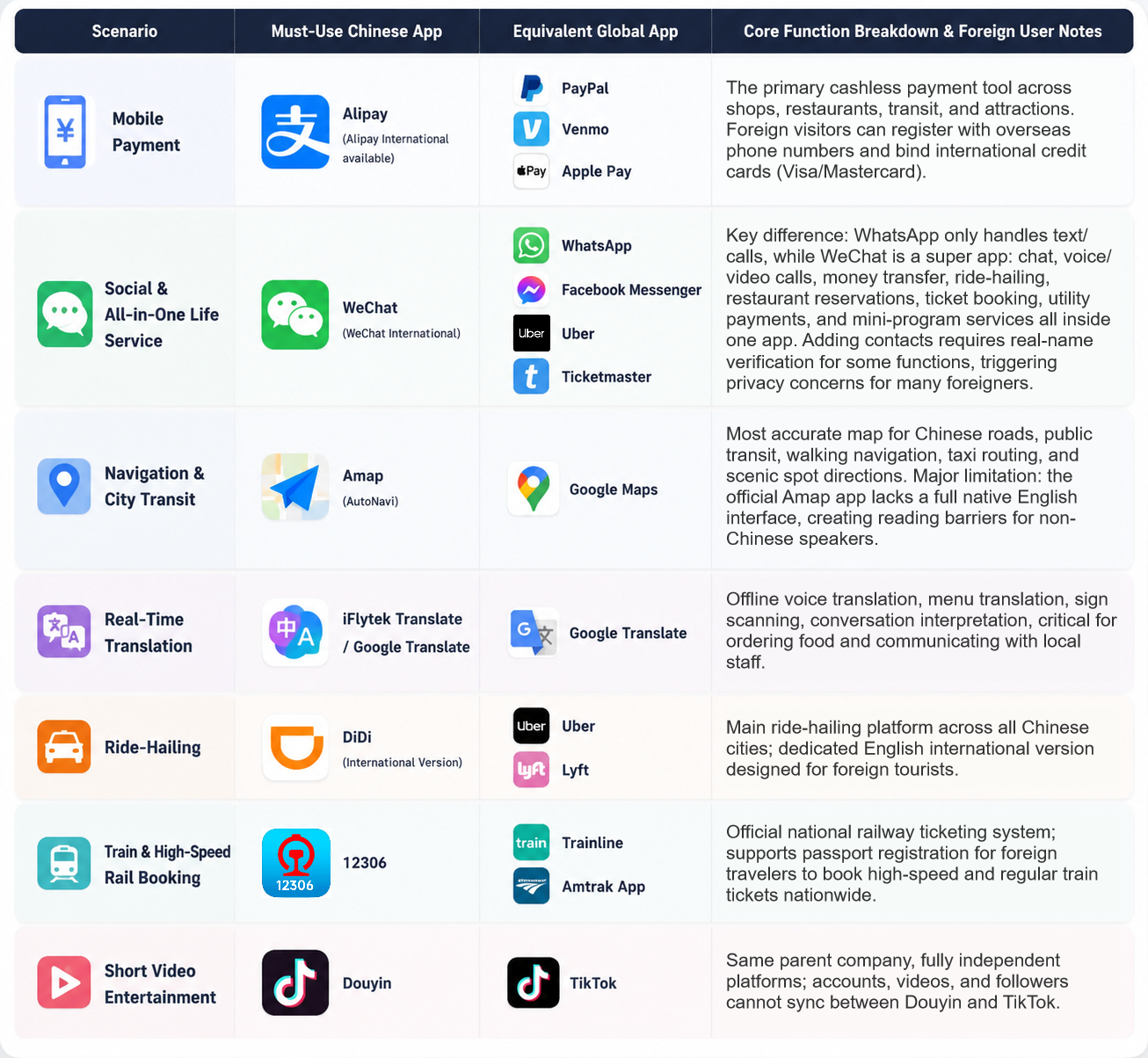
Part 2: Essential Chinese Travel Apps + Direct Global App Mapping for Foreign Visitors
This side-by-side comparison helps foreign travelers quickly match familiar apps with their required Chinese alternatives, eliminating confusion about learning.
Part 3: Common Pain Points Foreign Tourists Encounter With Chinese Apps
1. Super App Overload & Confusing Interface Layout
Foreign users are conditioned to one app = one job. WeChat and Alipay pack dozens of hidden service entries, nested mini-programs, and multi-layer menus. New visitors easily get lost trying to find payment, ride-hailing, or ticket functions within the super app structure.
2. Registration Barrier: Mandatory Chinese Phone Number Requirement
Some domestic apps require a mainland China mobile SIM card to receive verification codes for sign-up. Travelers arriving for short trips have no easy way to obtain a local number upfront, blocking app access entirely.
3. Real-Name Verification Anxiety & Privacy Worries
WeChat requires real-name authentication (passport or ID binding) to send money, add new contacts, or use certain payment features. Many European and American tourists view submitting identity documents to foreign platforms as a privacy risk, refusing to complete verification, and missing core app functionality.
4. Missing or Incomplete English Interfaces
Amap, Meituan, and many local service apps do not offer full official English versions. Menus, settings, and order details remain in Chinese, making self-guided navigation, food ordering, and ticket booking extremely difficult.
5. Confusion Between Douyin and TikTok
Most international travelers assume they can log into TikTok with a Douyin account or cross-share content, unaware that the two platforms are fully isolated, leading to login failures and frustration.
6. Fragmented Payment & Operation Complexity
Even after registering Alipay/WeChat, linking international cards, understanding QR-code payment logic, and troubleshooting failed transactions, creates a steep learning curve for first-time visitors.
Part 4: Targeted Solutions to Resolve App-Related Travel Difficulties
Solution 1: Pre-Trip Preparation Before Entering China
Download Alipay International and WeChat International in advance, complete pre-registration with your overseas phone number, and prepare your passport for identity verification if needed.
Purchase a tourist China SIM card or eSIM online before departure to receive verification codes for app registration immediately upon landing.
Learn the basic difference between Douyin and TikTok, and avoid attempting cross-platform account logins.
Save offline translation packs to Google Translate or iFlytek to interpret Chinese app interfaces on demand.
Solution 2: On-Site Workarounds for Language & Registration Issues
Use browser translation plugins or phone system screen translation to interpret Chinese-only apps like Amap while navigating.
Carry small amounts of RMB cash as a backup for merchants that struggle with foreign mobile payment setup.
Use DiDi’s official international edition instead of WeChat mini-program ride-hailing, which often lacks full English translation.
Solution 3: Professional Concierge Support From Into South China (Most Stress-Free Option)
As a professional inbound travel agency specializing exclusively in South China travel, Into South China eliminates nearly all app-related obstacles for international clients with customized, cross-culturally trained tour guides and full pre-arrival & on-location support:
Pre-trip consultation & app setup assistance: Our team walks you through WeChat/Alipay account registration, international card binding, real-name verification explanation, and clarifies privacy policies to ease your concerns. We clearly explain the independent operation of Douyin and TikTok to prevent confusion.
Multilingual, cross-culturally trained accompanying guides: Our English-speaking guides are familiar with foreign digital habits and the structural differences between Chinese super apps and global single-function apps. They operate navigation, payment, ordering, and ticketing apps on your behalf, explain menu navigation step-by-step, and translate all in-app Chinese content in real time.
Full-cycle travel operation service: We handle ride-hailing reservations, scenic spot ticket bookings, restaurant reservations, high-speed rail ticketing, and payment settlement entirely for you, so you never need to struggle with confusing app menus or registration rules independently.
Privacy-transparent communication: We clearly outline why Chinese platforms require identity verification, how your personal data is protected under Chinese regulations, and address all your data security concerns openly.
Final Conclusion
The divide between China’s super app ecosystem and the world’s specialized app system stems from decades of divergent internet development, regulation, and consumer habits; neither model is superior, only tailored to local market needs. While navigating domestic Chinese apps creates inevitable hurdles for first-time foreign tourists, thorough pre-trip planning and professional support remove nearly all friction.
With dedicated assistance from Into South China, you can fully bypass complicated app setup, language barriers, and privacy uncertainties, focusing entirely on exploring Guangzhou, Lingnan culture, Cantonese cuisine, and the unique charm of South China during your trip.