
Some places you visit. Others, you feel in your bones. Chaoshan, the cultural heartland of eastern Guangdong, is the latter. This is where the Teochew people, known for their maritime spirit, exquisite craftsmanship, and legendary cuisine, have preserved a way of life that stretches back over a millennium. Here, the sea is not just a view; it is a livelihood, a pantry, and a source of identity. The streets are not just thoroughfares; they are open-air museums where ancient rituals and modern life coexist in perfect harmony.
This is not a tour for those who rush. This is a journey for travelers who want to live the Chaoshan way: to walk the same cobblestones that merchants trod a thousand years ago, to taste beef that was butchered hours before it reaches your table, to watch the sun set over a sea that has sustained generations of fishermen, and to feel the thunderous rhythm of the Yingge Dance, the "War Dance of China", reverberate through your chest.
Over six days, you will move through three distinct worlds: the ancient, scholarly charm of Chaozhou; the vibrant, cosmopolitan energy of Shantou; and the untamed, windswept beauty of Nan'ao Island. And throughout it all, you will be accompanied by a local guide, born and raised in Guangdong, fluent in the rhythms of Chaoshan life, who will not just show you the sights but introduce you to the people, the stories, and the flavors that make this corner of China utterly unforgettable.
Chaozhou: The City of a Thousand Years
The journey begins in Chaozhou, a city that feels like it has been preserved in amber. For over a thousand years, this has been the cultural and spiritual capital of the Teochew people, a place where scholars once composed poetry, merchants built fortunes, and artisans perfected crafts that would be passed down through generations.
Your first morning in Chaozhou begins not with a hotel breakfast, but with a walk across the Guangji Bridge, the world's oldest movable bridge and one of China's four great ancient bridges. The locals call it the "bridge that can be taken apart." By day, eighteen wooden boats linked by iron chains connect the two banks, forming a stable crossing. By late afternoon, as if by magic, the boats are disconnected and floated away, allowing ships to pass through. Watching this daily ritual, a practice that has continued for over eight hundred years, is like witnessing history come alive. As you stand on the bridge, your guide will point across the Han River to the green hills beyond, explaining how this waterway once carried Teochew merchants to Southeast Asia and beyond, carrying with them the seeds of a global diaspora.
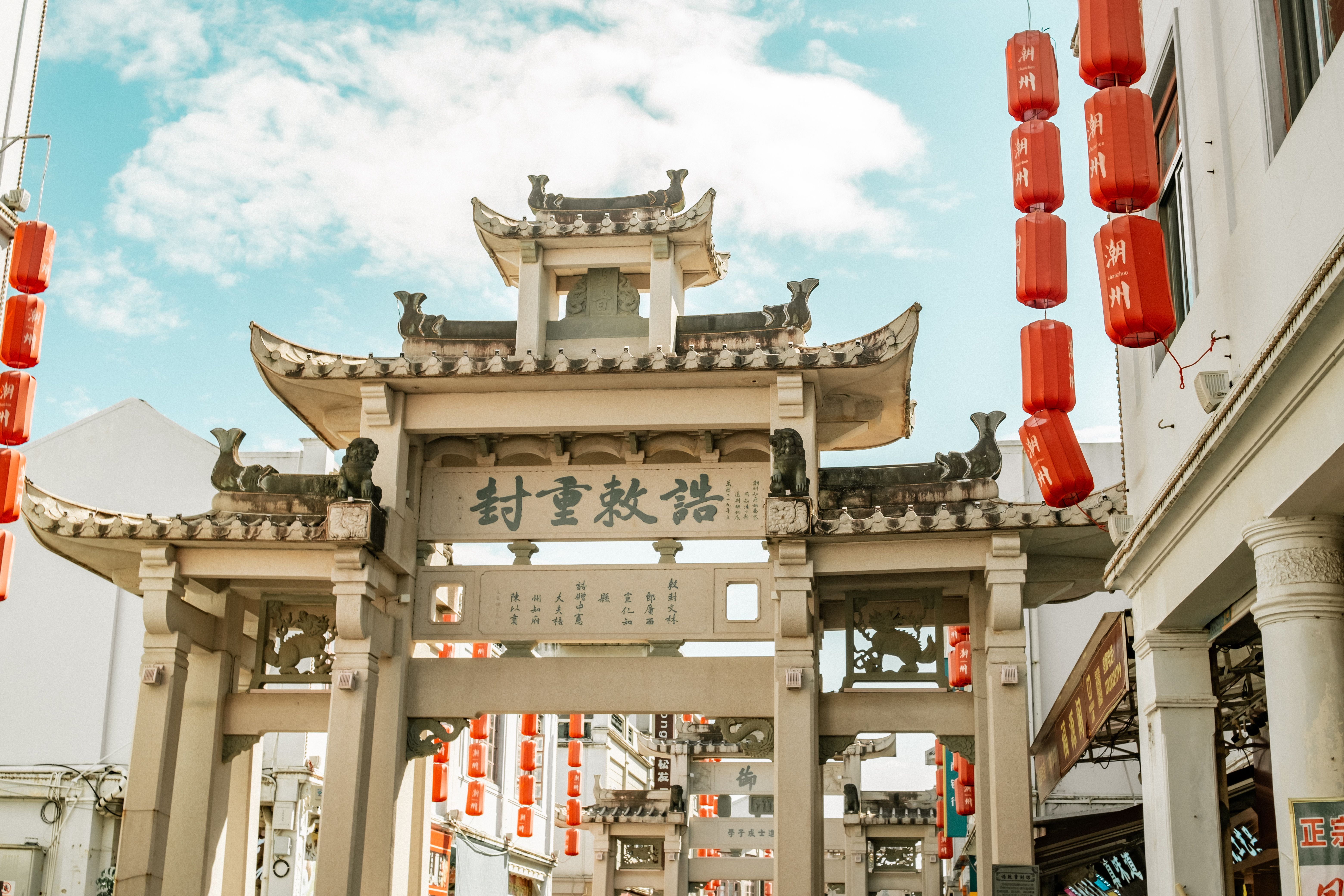
Dating back to the Ming Dynasty, the Haoci Chongfeng Arch stands proudly along Chaozhou Paifang Street. Traditional Lingnan stone craftsmanship, red Chaozhou lanterns, and clear blue skies blend to capture the timeless charm of Guangdong’s ancient Chaozhou city.
From the bridge, you step into the heart of Chaozhou: Paifang Street (牌坊街), a long, pedestrian avenue lined with twenty-three majestic memorial archways, each one commemorating a scholar, a statesman, or a virtuous citizen from centuries past. These stone monuments, some dating back to the Ming and Qing dynasties, rise above the street like gateways to another era. The buildings that flank them are equally remarkable: traditional qilou (arcade houses) with ornate wooden balconies and red lanterns that glow warmly at dusk. Your guide will lead you not just along the main street but into the winding side alleys, where life continues as it has for generations. Here, you might see an elderly woman sorting dried seafood on her doorstep, or a craftsman carving intricate patterns into a block of wood, scenes that have played out in these same lanes for centuries.
Chaozhou is also a city of temples and scholars. Kaiyuan Temple, the oldest Buddhist temple in eastern Guangdong, dates back to the Tang Dynasty and houses some of the finest surviving Song Dynasty wooden architecture in southern China. Its red walls and ancient banyan trees create an atmosphere of profound tranquility, a stark contrast to the bustling streets outside. Nearby, Hanwen Gong Temple, a shrine dedicated to the great Tang Dynasty scholar Han Yu, who was exiled to Chaozhou and helped civilize the region, offers a panoramic view of the entire city from its hillside perch. Standing here, looking down at the Han River and the ancient rooftops below, you begin to understand why Chaozhou has inspired poets for a thousand years.
But Chaozhou is not just a museum of the past. It is a living, breathing city where tradition is woven into daily life. In the afternoon, your guide will take you to meet a master of one of Chaozhou's many intangible cultural heritage crafts. You might watch a Chaozhou embroidery artist create intricate patterns with threads so fine they seem to float on the fabric. You might try your hand at shaping a hand-pulled clay teapot, a craft that requires years of practice to master. Or you might learn the delicate art of Chaozhou paper cutting, creating your own souvenir to take home. These are not performances for tourists; they are living traditions, passed down through families and maintained by masters who take pride in sharing their skills with curious travelers.
As evening falls, the city transforms. The lanterns on Paifang Street flicker to life, casting a warm glow on the ancient stone and wood. The Guangji Bridge, now lit with colored lights, becomes a ribbon of color across the dark river. And the scent of simmering broths and sizzling woks drifts from countless kitchens, promising a feast to come. Tonight, you will dine on Chaozhou beef hotpot, perhaps the city's most famous culinary export. The beef, sourced from local cattle and butchered just hours earlier, is sliced paper-thin and presented on platters that list the cuts like a wine menu: diaolong (tenderloin), shibing (tendon), wuhuazhi (five-flower tendon), each with its own recommended cooking time, measured in seconds. A dip in the clear, savory broth, a swirl in the rich satay sauce, and you understand why Teochew people say that the best beef is the beef you eat in Chaozhou.
Shantou: The Gateway to the Sea
From Chaozhou, a short drive brings you to Shantou, a city that embodies the spirit of the Teochew diaspora. While Chaozhou looks inward to its ancient traditions and scholarly heritage, Shantou looks outward to the sea, to the world, to the millions of Teochew descendants who spread across Southeast Asia, the Americas, and beyond.
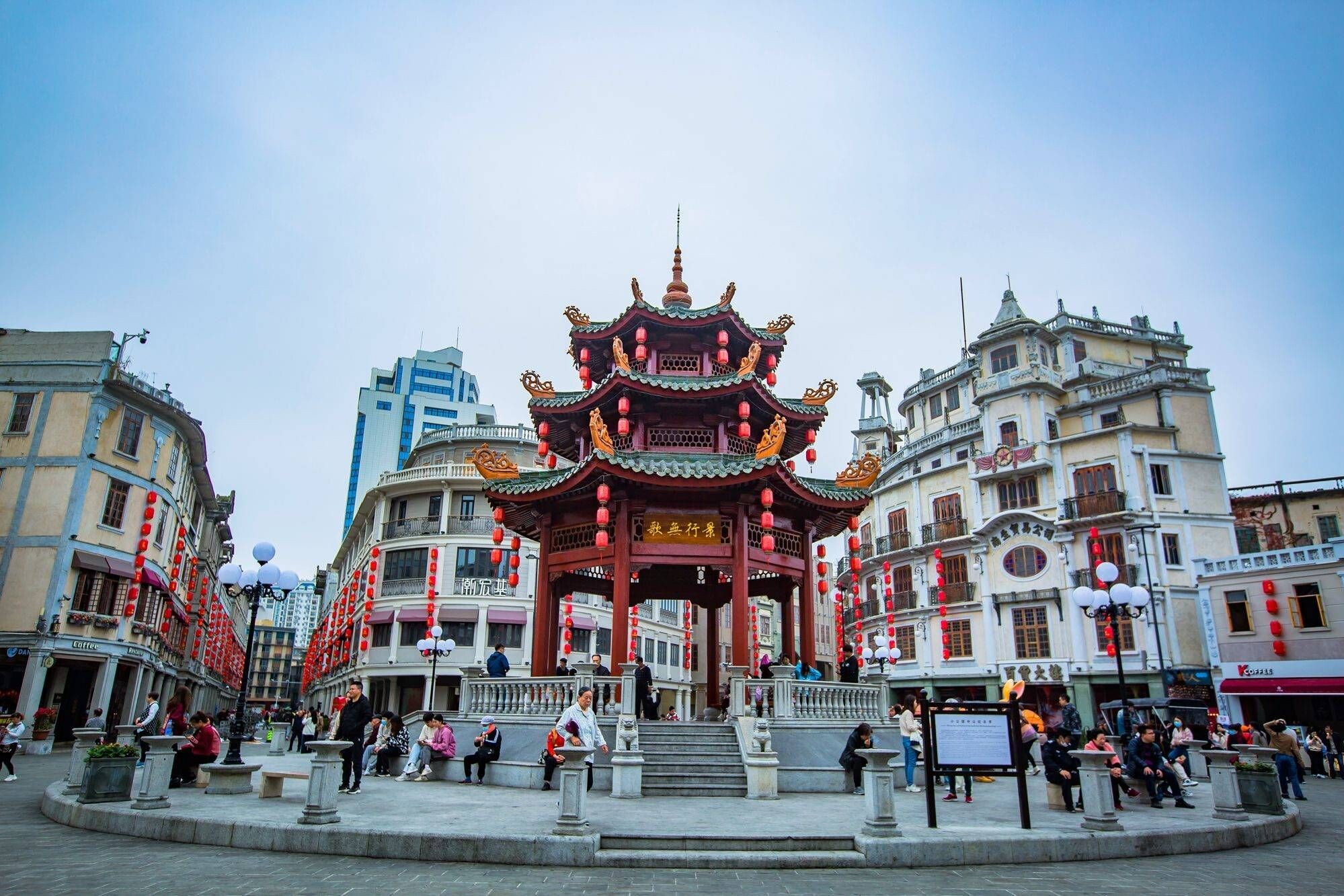
This is Little Park, the cultural landmark of Shantou’s historic Qilou district. The elegant three-tiered Chinese pavilion sits surrounded by well-preserved colonial-style Nanyang arcades, strung with red lanterns that highlight the unique blend of Chaoshan and Southeast Asian architectural charm.
The heart of Shantou is its Old Town, centered around the iconic Xiaogongyuan (Little Park) and its surrounding arcade streets. This is one of the best preserved qilou districts in China, a remarkable collection of over six hundred buildings constructed in the early twentieth century by overseas Chinese who returned home with fortunes made in the Nanyang (Southeast Asia). The architecture is a stunning fusion of styles: European columns and arched windows sit alongside traditional Chinese decorative motifs; Art Deco flourishes mingle with intricate wood carvings. Walking through these streets, under the covered arcades that shield pedestrians from the subtropical sun, you feel as if you have stepped into a living museum of the Chinese diaspora.
Your guide, a lifelong Shantou resident who grew up hearing stories of relatives who sailed to distant shores, will lead you through the maze of lanes, pointing out the faded shop signs that hint at the city's mercantile past: "Exchange," "Foreign Trade," "Remittance". You will visit the Shantou Opium War Museum and the Overseas Chinese Remittance Museum, where the story of the Teochew diaspora comes to life: the hardships of the journey, the emigrants' successes, and the enduring connection to the homeland. At the center of it all stands the Zhongshan Memorial Pavilion, a hexagonal pavilion that serves as the symbolic heart of the old city.
But Shantou is not just about history. It is also the culinary capital of the Chaoshan region, and your guide will ensure you taste its best offerings. In the afternoon, you might visit a local food market where vendors sell everything from live seafood to dried herbs to the famous Chaoshan fermented soybeans that give the region's cuisine its distinctive umami depth. You will sample oyster omelets (hao lai), crispy on the outside and tender within, served with a drizzle of fish sauce. You will try steamed rice rolls (changfen), silky and thin, filled with shrimp or beef and topped with a savory soy sauce. And you will discover the addictive pleasure of marinated crab (sheng yan), raw crab marinated in soy sauce, garlic, and chili, with a custard-like texture that Teochew food lovers consider the ultimate delicacy.
In the evening, the old town takes on a different character. The arcades are lit with warm yellow light, and the streets fill with locals enjoying the cool night air. Your guide will take you to a night market where you can sample an even wider array of street foods, from grilled squid to sweet red bean pastries to the refreshing duck shiitake lemon tea, made with the famous Phoenix Mountain oolong that is a Chaozhou specialty. As you walk, your guide will share stories of the city's past: the typhoons that devastated the port, the waves of emigration that depopulated entire villages, and the resilience of a people who always found their way back home.
Nan'ao Island: Where the Land Meets the Sea
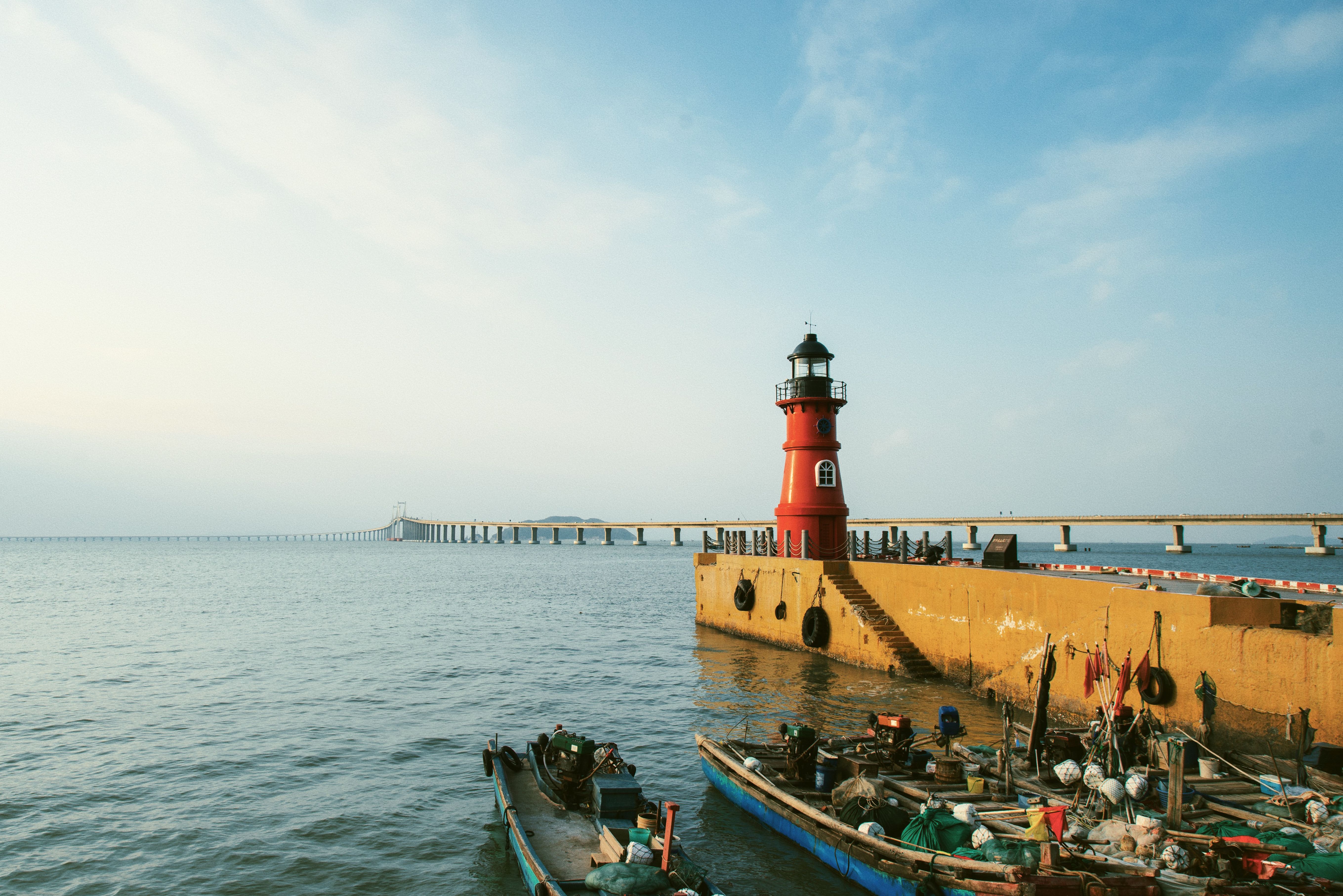
Perched on the fishing pier of Nan'ao Island, Changshanwei Lighthouse is the iconic first landmark after crossing Nan'ao Bridge
From Shantou, you cross the Nan'ao Bridge, a stunning sea-crossing bridge that connects the mainland to the island that has been a vital part of Teochew life for centuries. Nan'ao is not just a pretty island; it is a living, working community where fishing remains the primary livelihood, and where the rhythms of the sea dictate the rhythms of daily life. The island is also unique for being one of the few places in China where the Tropic of Cancer passes through, a fact celebrated by the "Gate of Nature" monument at Qing'ao Bay.
Your guide will take you on a loop around the island, following the coastal road that offers ever-changing views of the sea. You will stop at the Changsanwei Lighthouse, a red and white structure perched on a rocky promontory, offering panoramic views of the bridge and the mainland beyond. You will visit the "Rainbow Sea," a stretch of water dotted with colorful floating markers used by local oyster farmers, a scene that has become an iconic image of the island. And you will walk along the sandy shores of Qing'ao Bay, where the sand is fine, and the water is clear enough to see your own reflection.
But the real highlight of Nan'ao is the chance to experience the island's fishing culture firsthand. In the morning, you might join a local fisherman on his boat, helping to haul in the night's catch and learning the names of the fish in Teochew dialect. In the afternoon, you might visit a seafood market where the day's catch is sold directly from the boats, a chaotic, vibrant scene of bargaining, sorting, and laughter. And in the evening, you will dine on the fruits of the sea: freshly caught fish steamed with ginger and spring onions, clams stir-fried with fermented black beans, and a bowl of seafood congee that tastes of the ocean itself.
For those seeking a deeper connection to the island's spiritual traditions, your guide can arrange a visit to a local temple where fishermen offer prayers for safe voyages, a practice that has continued for centuries, unchanged by the passage of time.
The Yingge Dance: The Heartbeat of Chaoshan
No journey through Chaoshan would be complete without experiencing the Yingge Dance (英歌舞), a thunderous, martial-art-infused folk dance that the Teochew people call the "War Dance of China". This is not a performance for tourists; it is a living tradition, practiced by villagers and performed at festivals, weddings, and community celebrations throughout the year.
The dance is a spectacle of raw power and precision. Dancers, their faces painted in elaborate patterns inspired by the heroes of the classic novel Water Margin, move in formation, striking wooden sticks together in a rhythm that echoes like thunder. The movements are a fusion of martial arts, opera, and dance, each gesture, each step, each strike carrying centuries of meaning. Your guide will take you to a village where the dance is still practiced by young and old alike, and you will have the chance to not just watch but to participate: to have your face painted, to learn a few basic moves, and to feel the exhilarating energy of the "War Dance" for yourself.
A Journey, Not a Tour
This is a journey that cannot be rushed. It is a journey that requires time, time to walk the ancient streets, to taste the subtle differences between cuts of beef, to watch the sunset over the sea, and to feel the rhythm of the Yingge Dance in your bones. It is a journey that rewards those who are willing to slow down, to listen, and to participate.
And it is a journey made possible by Into South China, a specialist inbound travel agency that connects travelers to the authentic heart of Guangdong, Guangxi, Hainan, Hong Kong, and Macau. Our guides are not just translators; they are lifelong residents of the region, steeped in its culture, its cuisine, and its stories. They have built relationships with the masters, the fishermen, and the families who open their doors to our guests, access that independent travelers simply cannot arrange on their own. From seamless logistics to insider access, we handle every detail, so you can focus on what matters: the taste of a beef hotpot, the weight of a Yingge dance stick in your hand, and the stories that connect you to a culture that has endured for a thousand years.
Client Review
"An unforgettable journey through South China's most breathtaking landscapes and cultural treasures. Every detail was perfectly arranged, from authentic local experiences to comfortable accommodations. Highly recommended for travelers seeking genuine immersion!"
Trip Highlights
- ✓
Authentic Local Experiences
Immerse yourself in daily life, culture, and traditions of South China
- ✓
Scenic Natural Wonders
Breathtaking landscapes from karst peaks to tropical beaches
- ✓
Culinary Discoveries
Taste regional specialties and authentic local flavors
- ✓
Cultural Heritage Sites
Explore ancient temples, historic architecture, and UNESCO sites


