China's high-speed rail network is a marvel, clean, punctual, and sprawling across the country. For a foreign visitor, however, the process of booking and boarding can feel like a puzzle, especially when language barriers and unfamiliar systems appear. This guide, prepared by Into South China, breaks down every step from downloading the app to stepping off the train, while addressing the data privacy and payment concerns that weigh on many international travelers' minds. By the end, you will navigate the stations with the confidence of a local.
1. Download the Official App and Get Started
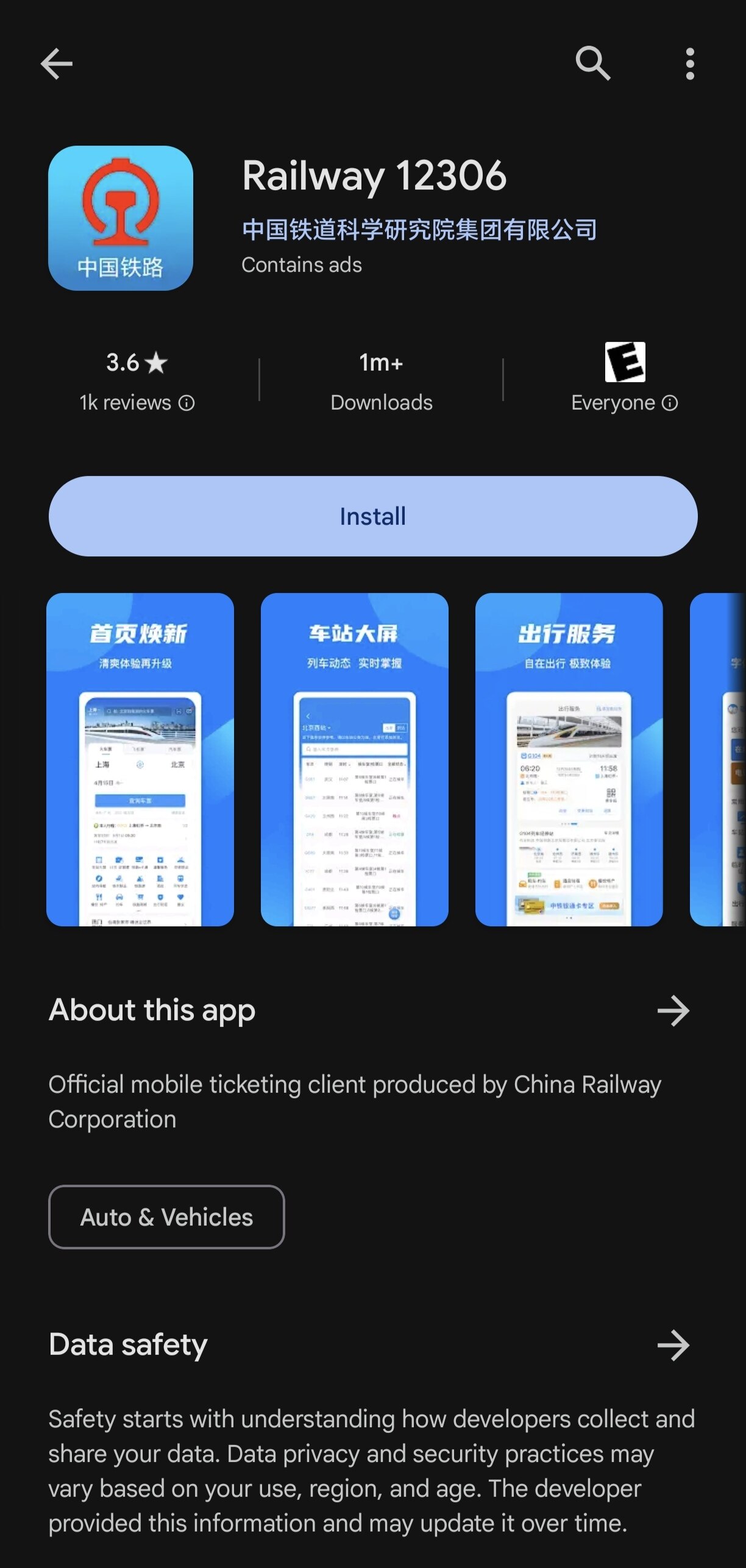
Download "Railway 12306" from the App Store or the 12306 official website
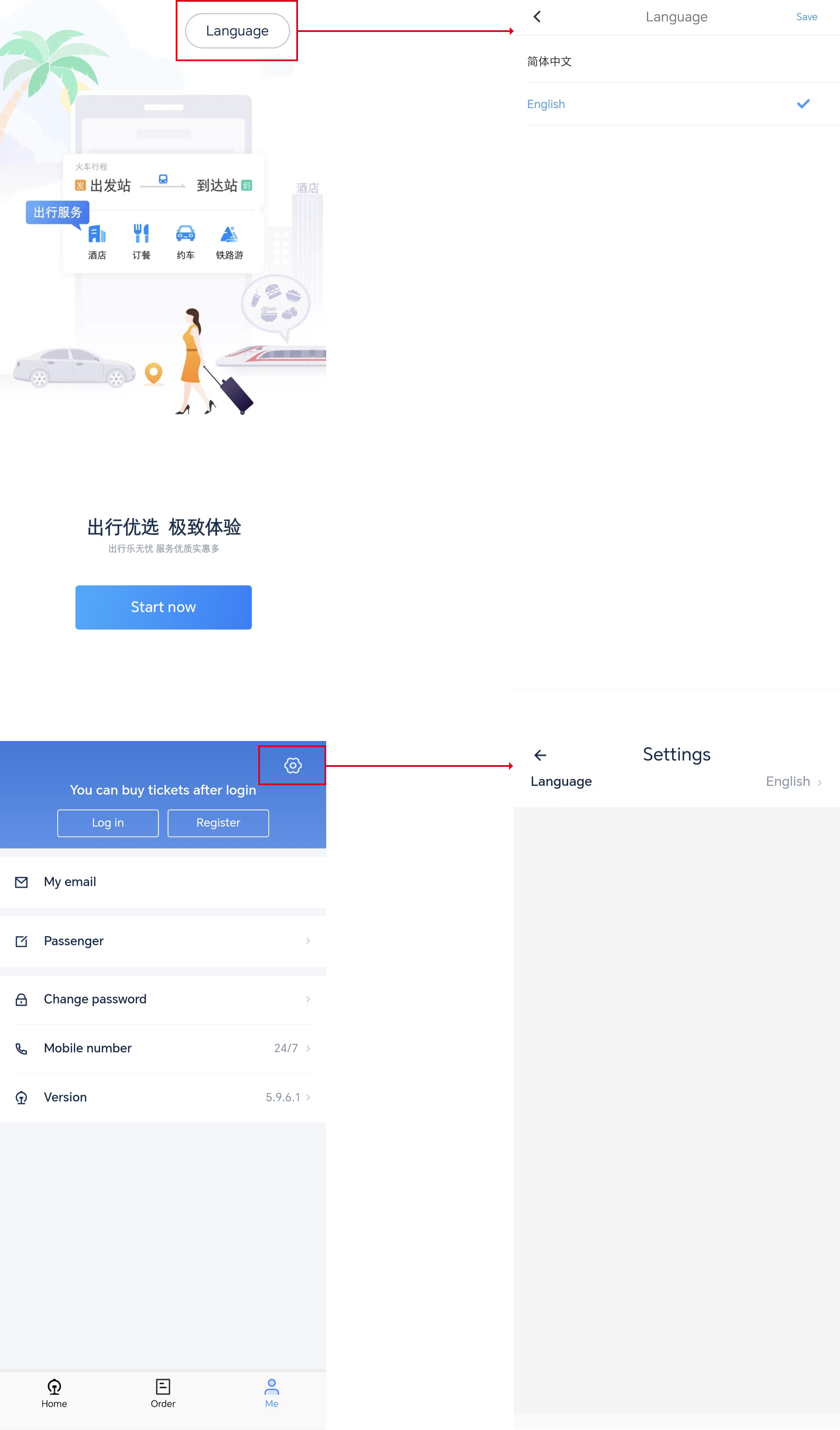
Open the app and tap the language switcher in the top right to select English
The first step is getting the right tool. Open Google Play on your phone and search for "Railway 12306". Look for the developer "China State Railway Group Co., Ltd." to ensure you have the official version, never a third-party copycat. After installation, open the app and tap the language switcher in the top corner to select English.
Before you register, a natural question may arise: why does a train ticket app need so much personal information? China's railway system operates on real-name ticketing, a policy similar to the passenger identity verification you encounter when booking an international flight. Your passport data is required for security and public safety purposes, and it is managed under China's data protection laws. The app does not sell your data to advertisers; it is used strictly for ticket verification and travel management. If you remain uneasy, you can always skip the app entirely and buy tickets at any station counter with cash, which we cover later.
2. Register and Verify Your Identity
To create an account, tap "Register" and select "Passport" as your ID type. Enter your passport number, full name exactly as it appears on the bio page (no abbreviations, no spaces where none exist), a valid email address, and a password. Submit the form.
The critical next step is identity verification. Without it, you cannot book tickets online. Go to "My" > "Passengers" > "Add", fill in your passport details again, and submit. The system may approve you automatically within a few hours, but often it cannot, and that is normal. When the automated check fails, you must do a one-time, in-person verification. Take your physical passport to any railway station ticket window (not a ticket machine). A staff member will scan your passport and confirm your details on the spot. Once verified, your account is permanently linked, and you can buy all future tickets online.
3. Booking Tickets
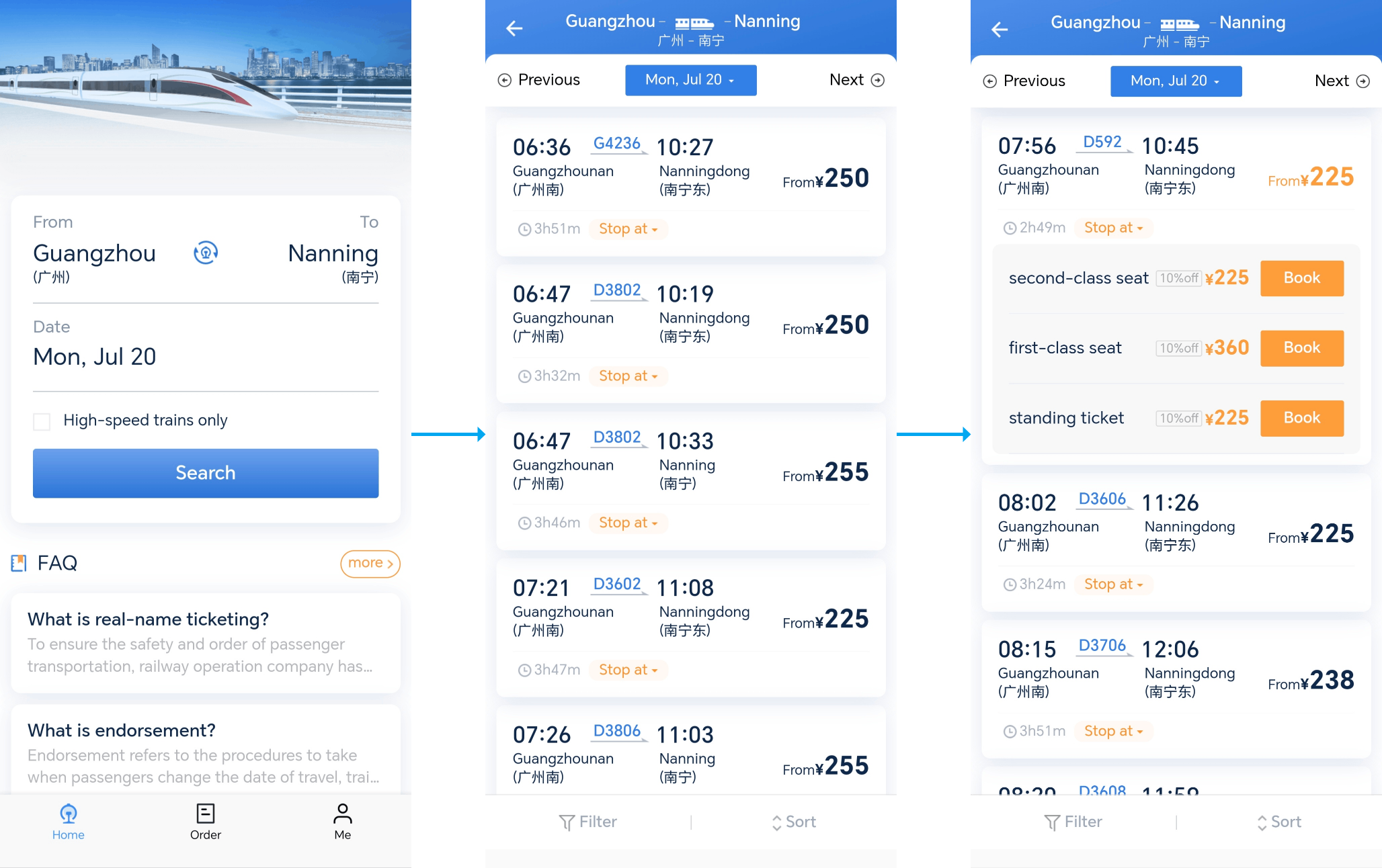
On the home screen, enter your departure city, destination, and travel date, then click the "Search" button
After verification, buying tickets is straightforward. On the home screen, enter your departure city, destination, and travel date. Note that most large cities have multiple stations; Guangzhou alone has Guangzhou South, Guangzhou East, and Guangzhou Railway Station. Double-check which one you need. Select a train, and you will see the seat classes: second class (comparable to economy on a plane), first class (wider seats, fewer people), and business class (lie-flat seats). Tap your choice.
You will be asked to select a passenger from your own verified profile. Then proceed to payment. The 12306 app accepts several methods that can work for foreign travelers. If you have set up Alipay or WeChat Pay and linked an international Visa or Mastercard, you can pay directly through those wallets. The app also accepts UnionPay cards, and in some cases, foreign-issued Visa and Mastercard directly, though this can be inconsistent. An alternative is to use a friend's Alipay or WeChat account to pay, as long as the ticket itself is in your name. If none of these work, you can always reserve a ticket online and then pay for it within 30 minutes at a station window, but a simpler route for the less digitally inclined is to buy in person from the start.
4. Buying Tickets Offline
For those who prefer not to share data online or cannot get the app to work, the station counter is a reliable backup. Go to any railway station ticket window with your passport. Write down or show on your phone your departure station, destination, travel date, and preferred train number or time window. The clerk will enter your passport details, and you will pay with cash (Chinese yuan) or a UnionPay card. You will receive a paper ticket or a confirmation slip. Hold onto it; you need it to board.
Ticket vending machines are largely off-limits for foreigners, as they only accept Chinese ID cards or permanent residence permits. Do not waste time trying.
5. Entering the Station and Boarding
On your travel day, arrive at the station at least 30 minutes early for smaller stations, and 45 to 60 minutes ahead for huge hubs like Guangzhou South. You cannot enter the station without your original passport. Copies, photos, or digital scans are not accepted.
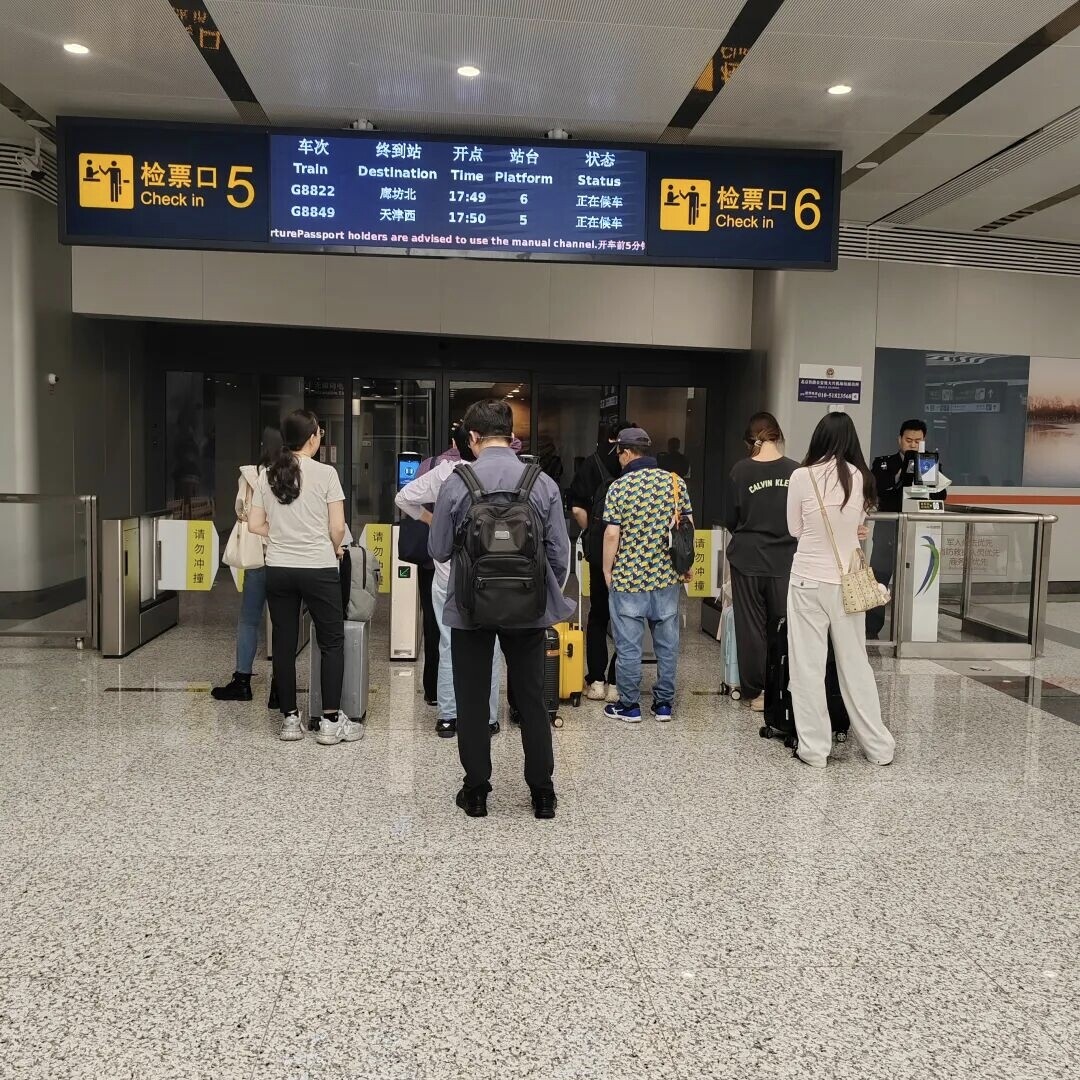
Foreigners with a standard passport, please use the manual channel
Walk to the station entrance, where you will see gates for ID checks. Most gates are automated, but they only read Chinese IDs. Foreigners with a standard passport must use the manual channel, usually marked with a staff member or a "Manual Verification" sign. Hand over your passport and, if you have a paper ticket, that as well. The staff verifies your identity, and you proceed to the security check.
Security is similar to an airport: place your bags on the belt, walk through the metal detector. Rules are common sense: no flammable items, no knives, no e-cigarettes indoors. Once through, look at the large departure boards for your train number and platform. Platforms are clearly numbered, and signs on the floor show where your carriage will stop. Board quickly; doors close about two minutes before departure.
6. On the Train
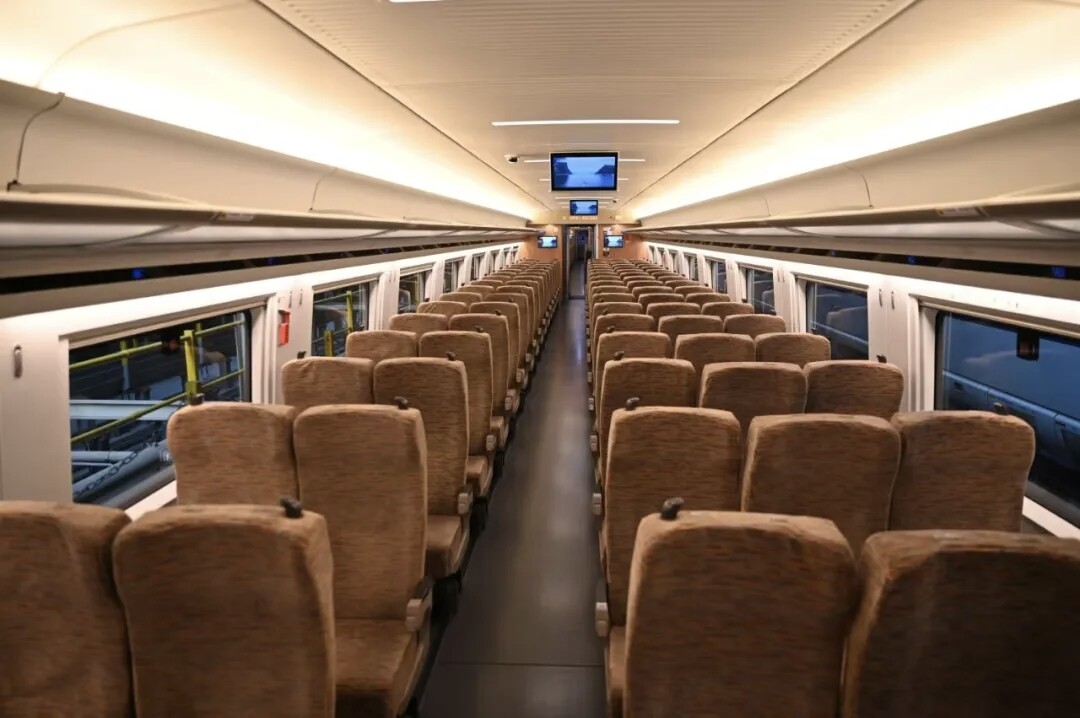
Find your seat according to the number printed on your ticket or app. Place small bags under the seat or in the overhead rack. The ride itself is smooth and quiet. Trains have power outlets at every seat, clean toilets, and a dining car or snacks for sale. Keep your mobile phone on silent mode, and step into the vestibule area between carriages if you need to make a call.
A train attendant may come through to verify documents again during the trip, so keep your passport handy. If you plan to get off at an intermediate station, do so quickly, as stops are brief.
7. Changes, Refunds, and Help
If your plans change, you can modify or cancel tickets through the app up to a certain time before departure, or at a station window. Refund fees depend on timing. If you lose something on board, call the 12306 hotline (English service is available) or speak to any station staff.
Into South China Makes It Even Easier
While this guide gives you the tools to master Chinese high-speed rail independently, we understand that when you are on vacation, even small details can become big headaches. That is what Into South China does: we handle ticket bookings, station transfers, hotel arrangements, and local experiences across Guangdong, Guangxi, Hainan, Hong Kong, and Macau. For a seamless journey where you simply show up with your passport and we take care of the rest, reach out to us. Your South China adventure deserves a smooth ride, from start to finish.